
Eucanthus impressus
Howden, 1964
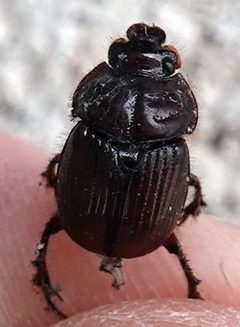
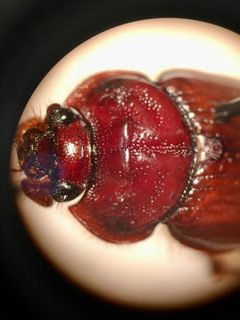
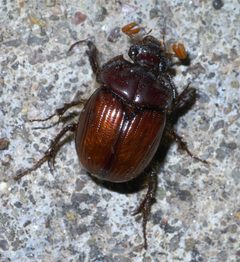
Eucanthus impressus is a of earth-boring scarab beetle in the Geotrupidae, Bolboceratinae. It was described by Henry Howden in 1964 and is distributed across much of North America, with records from the United States and northern Mexico. The species belongs to a group of beetles commonly known as earth-boring scarabs due to their habits.
Pronunciation
How to pronounce Eucanthus impressus: //juːˈkænθəs ɪmˈprɛsəs//
These audio files are automatically generated. While they are not always 100% accurate, they are a good starting point.
Identification
May be confused with other Eucanthus and members of related such as Bolbocerosoma. Distinguished by the specific pattern of elytral and pronotal punctation as described by Howden (1964). The species shows considerable color variation across its range, with eastern typically brighter green and western populations more yellow-green to dark purple.
Images
Habitat
Found in association with animal in woodland , particularly in high-quality forested areas. have been observed on mild days in late fall and early winter. The utilizes dung for both larval development and adult feeding, though adults may also feed on fungus and leaf litter.
Distribution
Broadly distributed across eastern and central North America. Recorded from Alabama, Arkansas, Colorado, Florida, Georgia, Illinois, Iowa, Kansas, Louisiana, Maryland, Mississippi, Missouri, Nebraska, New Jersey, New Mexico, North Carolina, Oklahoma, South Carolina, and Texas in the United States, and from Chihuahua in northern Mexico.
Seasonality
are active primarily in late fall and early winter, with observations from October until hard winter conditions set in. Adults are believed to emerge in late fall, overwinter, and mate in spring.
Diet
feed on animal and fungus. Larvae develop in dung or tightly packed leaf litter at the end of burrows in soil.
Life Cycle
emerge in late autumn, overwinter, and reproduce in spring. Larvae develop in subterranean burrows provisioned with or leaf litter by the adult female.
Behavior
are often found singly on animal or on the ground nearby. They are capable of utilizing both dung and leaf litter for larval provisioning, showing more flexible food choice than true dung beetles (Scarabaeinae).
Ecological Role
Contributes to nutrient cycling through burial of and organic matter. As with other geotrupids, plays a role in soil aeration and decomposition processes.
Human Relevance
No significant direct economic importance. Occasionally encountered by entomologists and naturalists in woodland .
Similar Taxa
- Eucanthus lazarusSimilar size and general appearance, but distinguished by differences in pronotal and elytral punctation patterns
- Bolbocerosoma speciesRelated in same with similar habits, but distinguished by differences in antennal club structure and body proportions
- Geotrupes speciesSame but different ; Geotrupes typically lack the pronounced punctation of Eucanthus and have different antennal
More Details
Taxonomic History
The was described by Henry Howden in his 1964 revision of North American Bolboceratinae. Howden's work remains the primary taxonomic reference for this group.
Color Variation
Western (previously recognized as Eucanthus impressus miarophagus) show more variable coloration ranging from yellow-green with golden or reddish hints to dark purple, while eastern populations are more consistently bright green. The validity of subspecific distinction based on color alone has been questioned.
Sources and further reading
- BugGuide
- Wikipedia
- GBIF taxonomy match
- iNaturalist taxon
- NCBI Taxonomy
- Meloidae Holdings | Entomology Research Museum
- Cicindelidae | Beetles In The Bush | Page 6
- You know what bugs me about dung beetles?… | Beetles In The Bush
- tiger beetles | Beetles In The Bush | Page 5
- Florida | Beetles In The Bush
- Zygophyllaceae | Beetles In The Bush