
Saprinus
Erichson, 1834
clown beetles
Species Guides
22- Saprinus acilinea
- Saprinus ciliatus
- Saprinus coerulescens
- Saprinus discoidalis(clown beetle)
- Saprinus distinguendus(clown beetle)
- Saprinus felipae(clown beetle)
- Saprinus fimbriatus
- Saprinus ignotus
- Saprinus impressus(clown beetle)
Saprinus is a of clown beetles in the Histeridae, containing more than 200 described . Members are found on every continent except Antarctica. The genus includes species associated with carrion, , and other decaying organic matter, where they function as of other small insects. Some species have specialized associations with ants or .
Pronunciation
How to pronounce Saprinus: /ˈsæprɪnəs/
These audio files are automatically generated. While they are not always 100% accurate, they are a good starting point.
Identification
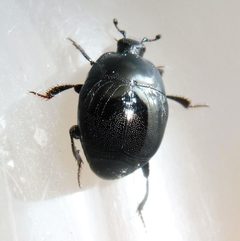
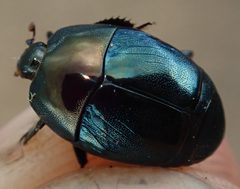
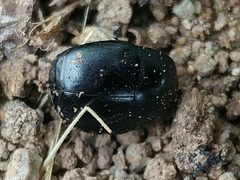
Saprinus are small, spherical, highly polished beetles with metallic luster. They can be distinguished from other histerid by the combination of compact body form, shortened that expose the , and characteristic antennal club structure. Specific species identification requires examination of genitalia and other fine morphological details.
Images
Habitat
in this occur in carrion, , decaying organic matter, and associated with or nests. Some species are found in forested , while others occupy open or disturbed environments.
Distribution
distribution on all continents except Antarctica. Specific have regional distributions; for example, Saprinus splendens is widely distributed, while Saprinus secchii is known from West and Central Africa (Ivory Coast, Benin, Senegal, Sudan, Republic of Congo, Democratic Republic of Congo).
Diet
Predatory on other small insects, particularly larvae found in carrion, , and decaying matter. Some filter-feed on dung.
Behavior
When disturbed, individuals play dead or quickly dig to conceal themselves. Some are myrmecophilous or termitophilous, living in association with or colonies.
Ecological Role
in decomposition , contributing to nutrient cycling by consuming other insects in carrion and . Some serve as indicators of decay stage in forensic contexts.
Human Relevance
Occasionally encountered in investigations due to their presence on carrion. No significant economic impact documented.
Similar Taxa
- Other Histeridae generaSimilar compact, shiny body form; distinguished by antennal structure, elytral striation patterns, and genital
- DermestidaeSome dermestid share small size and association with carrion; distinguished by elongated body form, clubbed with different structure, and setal patterns
More Details
Species diversity
Over 200 described , making it one of the larger in Histeridae
Specialized associations
Saprinus rarus is termitophilous, associated with arboreal nests; other are myrmecophilous
Taxonomic activity
Active revisionary work ongoing, with new described from underexplored regions such as the Australopacific
Sources and further reading
- BugGuide
- Wikipedia
- GBIF taxonomy match
- iNaturalist taxon
- NCBI Taxonomy
- Catalogue of Life
- Bug Eric: More Beetles from Bones
- Two new Clown beetle genera and 4 new species | Blog
- Revision of Saprinus (Saprinus) splendens (Paykull, 1811) with description of Saprinus (Saprinus) secchii n. sp. (Coleoptera: Histeridae)