
Lyconotus lateralis
(Melsheimer, 1846)
net-winged beetle
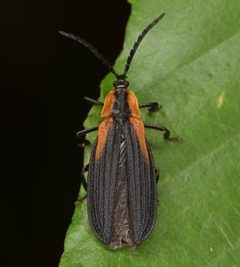
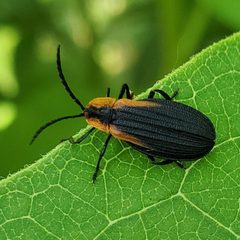
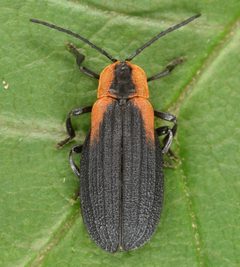
Lyconotus lateralis is a of net-winged beetle ( Lycidae) found in North America. The species was described by Melsheimer in 1846. Like other lycid beetles, it possesses aposematic coloration, typically appearing orange and black, which serves as a warning to of its unpalatability. The species has been documented in the southeastern United States, including Florida, where it has been observed on flowering vegetation such as Ilex cassine (dahoon holly).
Pronunciation
How to pronounce Lyconotus lateralis: /laɪkoʊˈnoʊtəs læˈtɛrəlɪs/
These audio files are automatically generated. While they are not always 100% accurate, they are a good starting point.
Images
Habitat
Found in woodland , including dry oak/pine sandhill woodland and wet sand forest. Observed on flowering vegetation, particularly on flowers of Ilex cassine (dahoon holly).
Distribution
North America; present in Mexico (MX) and the United States. Documented in Florida and other southeastern states.
Behavior
have been observed in mating pairs on flowers. The is and active during daylight hours. Notably unskittish when handled, possibly due to reliance on aposematic coloration for avoidance rather than .
Ecological Role
Serves as a Müllerian mimicry model for distasteful insects. The longhorned beetle Lycochoriolaus lateralis ( Cerambycidae) is a documented mimic of this and other lycid .
Similar Taxa
- Lycochoriolaus lateralisCerambycidae that mimics Lyconotus lateralis and other lycid beetles; distinguished by length and elytral structure