
Nematodes penetrans
(LeConte, 1852)
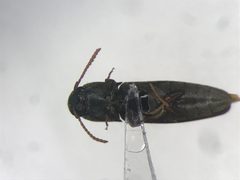
Nematodes penetrans is a of false click beetle in the Eucnemidae, first described by John Lawrence LeConte in 1852. The name 'Nematodes' refers to the thread-like or worm-like appearance of these beetles, not to worms. As a member of the Eucnemidae, it belongs to a group of beetles commonly known as false click beetles, which are distinguished from true click beetles (Elateridae) by their reduced ability to produce the characteristic clicking sound. The species has been documented in eastern Canada and parts of the northeastern United States.
Pronunciation
How to pronounce Nematodes penetrans: //nɛˈmætəˌdiːz ˈpɛnɪˌtrænz//
These audio files are automatically generated. While they are not always 100% accurate, they are a good starting point.
Images
Distribution
Eastern Canada: recorded from New Brunswick, Nova Scotia, Ontario, and Quebec. The occurs in forested regions of the northeastern North American temperate zone.
Similar Taxa
- Eucnemidae (family)All members of Eucnemidae share the general body plan and reduced clicking mechanism that distinguishes them from true click beetles (Elateridae). Nematodes penetrans can be separated from other eucnemid by its specific morphological characteristics as defined in LeConte's original description.
- Elateridae (family)True click beetles possess a well-developed prosternal process that fits into a mesosternal cavity, enabling the characteristic clicking/jumping defense mechanism. Eucnemidae including Nematodes penetrans have this mechanism reduced or absent, appearing more flattened and less able to click.
Misconceptions
The name 'Nematodes' frequently causes confusion with worms ( Nematoda). This genus was named for the thread-like or worm-like body form of its members, not for any biological relationship to actual nematodes. The epithet 'penetrans' similarly refers to or and does not indicate .
Sources and further reading
- BugGuide
- GBIF taxonomy match
- iNaturalist taxon
- NCBI Taxonomy
- More Nematodes in Outer Space? | Bug Squad
- Showcasing Animal and Plant Parasitic Nematodes | Bug Squad
- Don't Miss the Nematodes at UC Davis Biodiversity Museum Day | Bug Squad
- UC Davis Biodiversity Museum Day and the Fascinating World of Nematodes | Bug Squad
- Why You Ought to Be Concerned About Plant-Parastic Nematodes | Bug Squad
- Of French Fries, Couch Potatoes and Root-Knot Nematodes | Bug Squad
- Host Records and Spore Morphometrics of Pasteuria penetrans Group Parasites of Nematodes
- Maternal Stress Reduces the Susceptibility of Root-Knot Nematodes to Pasteuria Penetrans
- Nematodes in relation to plant growth. III. Pratylenchus penetrans (Cobb) in tree crops, potatoes and red clover.
- Re-evaluation of the life-cycle of the nematode-parasitic bacterium Pasteuria penetrans in root-knot nematodes, Meloidogyne spp.
- Indirect effects of the bacterial soil aggregation on the distribution of Pasteuria penetrans, an obligate bacterial parasite of plant-parasitic nematodes
- The 16S rRNA gene of Pasteuria penetrans provides an early diagnostic of infection of root-knot nematodes (Meloidogyne spp.)
- Diversity of the bacterial hyperparasite Pasteuria penetrans in relation to root-knot nematodes (Meloidogyne spp.) control on Acacia holosericea
- Effects of plant phenylpropanoid pathway products and selected terpenoids and alkaloids on the behaviour of the plant-parasitic nematodes Radopholus similis, Pratylenchus penetrans and Meloidogyne incognita
- Population diversity of Pasteuria penetrans from pepper fields and its genetic variation from single root-knot nematodes
- Host–parasite soil communities and environmental constraints: Modelling of soil functions involved in interactions between plant-parasitic nematodes and Pasteuria penetrans