
Ampedus sanguinipennis
(Say, 1823)
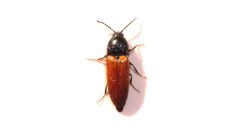
Ampedus sanguinipennis is a click beetle in the Elateridae, native to eastern North America. The name "sanguinipennis" refers to the blood-red wing coloration characteristic of this . It is one of numerous Ampedus species distinguished by bright coloration, often in red or orange tones. Records indicate presence in eastern Canada and the northeastern United States.

Pronunciation
How to pronounce Ampedus sanguinipennis: /ˈæmpɪdəs sæŋˌɡwɪnɪˈpɛnɪs/
These audio files are automatically generated. While they are not always 100% accurate, they are a good starting point.
Identification
The specific epithet "sanguinipennis" (blood-red wings) suggests reddish coloration of the or wings, a trait shared with several . Accurate identification to level in Ampedus typically requires examination of antennal structure, pronotal shape, and male genitalia. The species may be distinguished from similar red-colored Ampedus by subtle differences in body proportions and color pattern, though specific diagnostic features for this species are not documented in available sources.
Images
Distribution
Eastern Canada: New Brunswick, Nova Scotia, Ontario, Prince Edward Island, and Quebec. The range extends into the northeastern United States based on regional fauna patterns, though specific U.S. state records are not confirmed in available sources.
Behavior
As a member of Elateridae, possesses the clicking mechanism characteristic of the , where a prosternal spine engages with a mesosternal groove to produce a jumping motion when disturbed. Specific behavioral observations for this are not documented.
Similar Taxa
- Ampedus nigerrimusSimilar body form and size; distinguished by all-black coloration versus red wings of A. sanguinipennis
- Ampedus sanguinolentusShares red coloration and similar epithet; may require examination of male genitalia or antennal serration for separation
- Ampedus rufipennisOverlapping red-winged phenotype; limits in this color group of Ampedus require careful morphological study
More Details
Taxonomic Note
The Ampedus is currently classified in Elateridae, though it has historically been treated as a separate family Ampedidae or as a Ampedinae. The was originally described by Thomas Say in 1823, one of the earliest American entomologists.
Data Limitations
Detailed biological information for Ampedus sanguinipennis is sparse in accessible literature. Most Ampedus are poorly studied individually, with identification relying heavily on historical descriptions and regional faunal works. The 146 iNaturalist observations suggest the species is encountered with moderate frequency by naturalists, but these records lack systematic biological documentation.