
Eanus estriatus
(LeConte, 1853)
Estriate Click Beetle
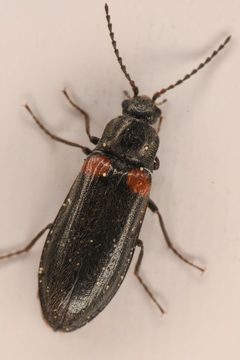
Eanus estriatus is a of click beetle in the Elateridae. It is known from scattered records across Canada. The 'Estriate Click Beetle' refers to its striated (grooved) . Like other members of Elateridae, it possesses the characteristic clicking mechanism for righting itself when overturned. The species was described by John Lawrence LeConte in 1853.
Pronunciation
How to pronounce Eanus estriatus: //ˈiːənəs ɛˈstraɪətəs//
These audio files are automatically generated. While they are not always 100% accurate, they are a good starting point.
Identification
The specific epithet 'estriatus' (meaning 'without ' or 'finely striated' depending on interpretation) suggests elytral is diagnostic. Distinguished from congeneric by elytral striation pattern and overall body form. Confirmation requires comparison with or authoritative keys to Eanus.
Images
Distribution
Recorded from western and central Canada: Alberta, British Columbia, Labrador, Manitoba, and New Brunswick.
Behavior
Possesses the click mechanism characteristic of Elateridae: when placed on its back, the can snap its body to propel itself into the air and right itself.
Similar Taxa
- Other Eanus speciesCongeneric share general body form and require careful examination of elytral , punctuation, and body proportions for separation.
- Other ElateridaeMany click beetles share similar elongate form; Eanus are distinguished by specific combinations of antennal structure, prosternal spine form, and elytral .
More Details
Taxonomic Note
The Eanus was established by LeConte in 1853 with E. estriatus as one of the included . The genus is relatively small and primarily Nearctic in distribution.
Data Limitations
This is poorly represented in collections and literature. The 11 iNaturalist observations suggest it is infrequently encountered or underreported. No detailed biological studies have been located.