
Hemicrepidius
Germar, 1839
click beetles
Species Guides
17Hemicrepidius is a of click beetles ( Elateridae) established by Germar in 1839. The genus contains multiple distributed across Europe, western Asia, and North America. Hemicrepidius hirtus, the only UK representative, has been extensively studied including complete sequencing as part of the Darwin Tree of Life project. are distinguished by serrate , non-convex , and characteristic pronotal and elytral .
Pronunciation
How to pronounce Hemicrepidius: //ˌhɛmɪˈkrɛpidiəs//
These audio files are automatically generated. While they are not always 100% accurate, they are a good starting point.
Identification
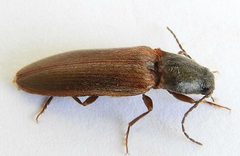
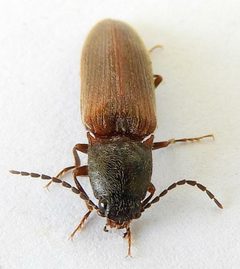
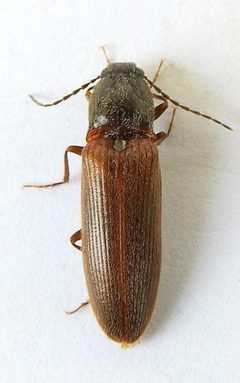
can be distinguished from other click beetle by: strongly serrate (not clubbed) with specific segment length ratios; not strikingly convex; pronotum black, broadest near hind angles that project backward; without confusing punctation or patterns; and 4th tarsal segment on mid and hind weakly bilobed and approximately one-third the size of the 3rd segment. These characters are documented for H. hirtus and may apply to .
Images
Habitat
Diverse preferences including both forested and open habitats. Specific microhabitat requirements vary by .
Distribution
Native to Europe and western Asia; recorded across the UK including Northern Ireland and Orkney (Scotland), and throughout continental Europe (Denmark, Norway, Sweden). Introduced and established in North America (Vermont, USA).
Diet
Larvae of at least H. hirtus have been demonstrated to be predatory based on stable isotope analysis from their native range, rather than herbivorous as initially suspected in introduced . Diet of other in the is not documented.
Ecological Role
Larvae function as in soil and litter . In its introduced North American range, H. hirtus was initially considered a potential agricultural pest, but stable isotope analysis revealed predatory rather than herbivorous feeding habits.
Human Relevance
H. hirtus was sequenced as part of the Darwin Tree of Life project, providing a high-quality reference genome (377.55 Mb, 99.2% BUSCO completeness) for studies of evolution and click beetle .
Similar Taxa
- Other Elateridae generaHemicrepidius is distinguished by the combination of serrate (not clubbed) , non-convex , and the specific structure of the 4th tarsal segment on mid and hind legs—characters that separate it from related in Dendrometrinae.