
Limonius californicus
(Mannerheim, 1843)
sugarbeet wireworm
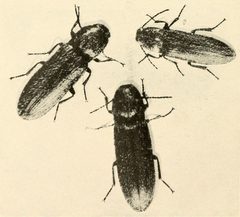
Limonius californicus, commonly known as the sugarbeet , is a click beetle in the Elateridae. The larval stage, referred to as wireworms, is an agricultural pest particularly associated with sugar beet and other crops in the northwestern United States and western Canada. males exhibit distinctive mate-finding , using olfactory cues to locate females that release a sex attractant shortly after .
Pronunciation
How to pronounce Limonius californicus: //lɪˈmoʊ.ni.əs ˌkæl.ɪˈfɔːr.nɪ.kəs//
These audio files are automatically generated. While they are not always 100% accurate, they are a good starting point.
Images
Habitat
Agricultural fields, particularly those with sugar beet and other susceptible crops. have been observed resting on small clods of earth with pointed upward into the breeze. Distribution extends across the northwestern United States and western Canadian provinces including Alberta, Saskatchewan, Manitoba, and British Columbia.
Distribution
Northwestern United States; western Canada including Alberta, Saskatchewan, Manitoba, and British Columbia.
Diet
Larval stage (wireworms) feeds on roots and underground portions of plants, causing damage to agricultural crops.
Life Cycle
Complete with , larval (), pupal, and stages. The larval stage is the damaging wireworm form.
Behavior
males rest on soil clods with oriented upward into the breeze and waving to detect female-released odours. Upon detecting a female, males move upwind by crawling or flying depending on wind velocity. Males become increasingly agitated as they approach females but often appear confused at close range, sometimes passing within inches without immediate recognition. Once a male successfully locates a female, mating occurs almost immediately; remaining males disperse after crawling repeatedly around and over the copulating pair.
Ecological Role
Agricultural pest in larval () stage; root-feeding damage affects crop yield and quality.
Human Relevance
Significant agricultural pest, particularly to sugar beet and other root crops. Subject of pest management research including geostatistical sampling methods and molecular characterization for improved control strategies. Sex attractant research has been conducted to understand and potentially exploit mating for monitoring or control.
More Details
Pheromone Research
Research has demonstrated that females release a sex attractant soon after , and that this attractant is separable by paper chromatography, suggesting potential for development of synthetic -based monitoring or control methods.
Sources and further reading
- BugGuide
- Wikipedia
- GBIF taxonomy match
- iNaturalist taxon
- NCBI Taxonomy
- Encyrtid Holdings | Entomology Research Museum
- California Has No State Bee--Yet! | Bug Squad
- Bohart Museum: Learn about California's State Insect on UC Davis Picnic Day | Bug Squad
- Grasshoppers of Colorado
- Sex Attraction Pheromone Improves Detection of a Threatened Beetle
- Just how widespread is Prionus heroicus? | Beetles In The Bush
- Characterizing the molecular biology ofLimonius californicusand its application to pest management
- Response of Males of Limonius californicus (Mann.) (Coleoptera: Elateridae) to a Sex Attractant Separable by Paper Chromatography
- Geostatistical Description of the Spatial Distribution of Limonius californicus (Coleoptera: Elateridae) Wireworms in the Northwestern United States, with Comments on Sampling