
Athous rufifrons
(Randall, 1838)
Red-fronted Click Beetle
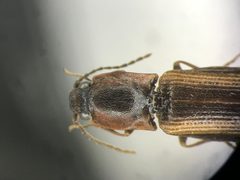
Athous rufifrons is a of click beetle ( Elateridae) described by Randall in 1838. The 'Red-fronted Click Beetle' refers to a distinctive color pattern on the or pronotum. Like other members of Elateridae, it possesses the characteristic clicking mechanism that allows the to right itself when flipped onto its back. The species is documented from eastern Canada with scattered observation records.
Pronunciation
How to pronounce Athous rufifrons: /ˈæ.θaʊs ˈru.fi.frɒnz/
These audio files are automatically generated. While they are not always 100% accurate, they are a good starting point.
Identification
The combination of reddish coloration (/pronotum) with the overall Athous body form distinguishes this from . Athous species are generally similar in appearance and require careful examination of antennal structure, pronotal shape, and color patterns for definitive identification. The specific color pattern implied by 'rufifrons' serves as a key diagnostic feature separating it from other Athous species in its range.
Images
Appearance
A moderately sized click beetle. The specific epithet 'rufifrons' (red-fronted) indicates reddish coloration on the (front of the ) or portion of the pronotum. Body form is elongate and somewhat flattened, typical of the Athous. are serrate (saw-like) to pectinate (comb-like), a common trait in the genus.
Distribution
Eastern Canada: recorded from Manitoba, New Brunswick, Newfoundland and Labrador, Nova Scotia, and Ontario. The distribution appears centered in the Canadian Maritimes and extends westward through Ontario to Manitoba.
Behavior
Possesses the characteristic elaterid clicking mechanism: a prosternal spine engages with a mesosternal groove to produce an audible click that propels the into the air, enabling it to right itself when overturned. This is shared across the Elateridae and is assumed present in this .
Ecological Role
Human Relevance
Some Athous larvae can be minor agricultural pests, feeding on crop roots. The significance of A. rufifrons in this regard is not documented. are occasionally attracted to lights.
Similar Taxa
- Athous brightwelliOverlaps in eastern Canadian range; distinguished by different pronotal and coloration patterns
- Athous acanthusSimilar body form and size; separated by antennal structure and coloration details
- Other Athous species members share elongate form and serrate ; require examination of specific color patterns and structural details for separation
More Details
Taxonomic Note
Described by John William Randall in 1838, originally placed in Elater before transfer to Athous. The specific epithet rufifrons (Latin: rufus = red, = forehead/) directly describes the diagnostic color feature.
Data Limitations
Available sources provide minimal biological detail. GBIF records indicate presence but not abundance; iNaturalist shows few observations (15), suggesting either genuine rarity or underreporting due to identification difficulty.