
Cardiophorus edwardsi
Horn, 1871
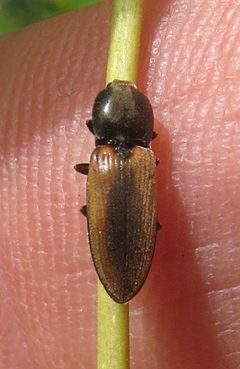
Cardiophorus edwardsi is a of click beetle in the Elateridae, first described by Horn in 1871. As a member of the Cardiophorinae, it possesses the characteristic -shaped prosternal process that gives the its name. The species is documented from western North America, with confirmed records from British Columbia, Canada. Like other click beetles, it is capable of the 'clicking' mechanism that allows it to right itself when flipped onto its back.
Pronunciation
How to pronounce Cardiophorus edwardsi: //ˌkɑr.diˈɒf.ɔːr.əs ˈɛd.wɚd.si//
These audio files are automatically generated. While they are not always 100% accurate, they are a good starting point.
Identification
Cardiophorus edwardsi can be distinguished from other Cardiophorus by specific characters of the prosternal process, elytral striation, and color pattern. The -shaped prosternal process is narrower and more elongate than in some . Accurate identification to species level typically requires examination of male genitalia and comparison with . It may be confused with other Cardiophorus species in western North America, particularly C. convexus and C. vestigialis, from which it differs in details of pronotal and elytral .
Images
Appearance
As a member of the Cardiophorus, this possesses the diagnostic -shaped prosternal process that extends posteriorly between the mesocoxae. The body is typically elongated and somewhat flattened, with that are serrate or pectinate. Members of Cardiophorinae often exhibit contrasting color patterns, frequently with yellowish or reddish markings on a darker background. The pronotum is usually wider than long with distinct angles.
Habitat
Based on -level characteristics and collection records, this inhabits forested and woodland environments. Members of Cardiophorus are typically found in association with dead wood, under bark, or in decaying plant material where their larvae develop. The British Columbia record suggests association with temperate coniferous or mixed forests.
Distribution
Documented from western North America. Confirmed records exist from British Columbia, Canada (GBIF). The full extent of its range within western North America requires further documentation.
Behavior
possess the characteristic click mechanism of Elateridae, using a prosternal spine that engages with a mesosternal groove to produce an audible click when the flexes its body. This allows the beetle to launch itself into the air and right itself when inverted. Adults are likely or , as is typical for the .
Ecological Role
As larvae, members of this function as saproxylic decomposers, contributing to nutrient cycling in forest by feeding on decaying wood and associated fungi. may visit flowers or feed on pollen, potentially serving as minor .
Human Relevance
Has been documented in entomological collections and biodiversity databases. No significant economic importance is recorded. Like many click beetles, it may occasionally be encountered by naturalists and entomologists in forest .
Similar Taxa
- Cardiophorus convexusOverlapping western North American distribution; differs in pronotal shape and elytral convexity
- Cardiophorus vestigialisSimilar size and coloration in western North America; distinguished by prosternal process and male genitalia
More Details
Taxonomic History
First described by George Henry Horn in 1871, a prominent American coleopterist. The epithet 'edwardsi' likely honors a collector or colleague, though the specific etymology is not documented in readily available sources.
Collection Records
The GBIF database records 30 iNaturalist observations and confirmed museum specimens from British Columbia, indicating the is documented but not frequently encountered by citizen scientists.