
Pissodes strobi
Say, 1831
white pine weevil, Engelmann spruce weevil
Pissodes strobi is a native North American weevil and significant forest pest that attacks young conifers, particularly white pines and spruces. emerge in spring from sites in forest floor duff to feed on shoots and mate. Females oviposit into the phloem of terminal leaders, where larvae feed and destroy growth tissues, often killing the infested stem section. The exhibits geographic variation in specificity, with western reared on Sitka spruce unable to colonize eastern white pine. Some host trees possess heritable resistance mechanisms that deter weevil .

Pronunciation
How to pronounce Pissodes strobi: /pɪˈsoʊdiːz ˈstroʊbaɪ/
These audio files are automatically generated. While they are not always 100% accurate, they are a good starting point.
Identification
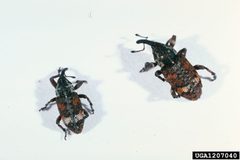
Dark brown coloration with white spots on the distinguishes from many other weevil . The association with terminal leader damage on young pines and spruces provides a contextual identification clue. Confirmation requires examination of the elongated rostrum and other morphological features typical of the Pissodes. Geographic origin may be relevant given documented -associated differences.
Images
Appearance
weevils are dark brown with distinctive white spots on the . The body is compact with the characteristic elongated snout (rostrum) typical of weevils. Size and detailed morphological measurements are not specified in available sources.
Habitat
Forest floor duff serves as and for . Active feeding, mating, and oviposition occur on stem sections and shoot leaders of young conifer trees. The is associated with pine and spruce forests where suitable host trees of appropriate age and size are available.
Distribution
Native to North America. Documented from Canada, the United States, and Mexico. Western occur in the Pacific Northwest, particularly coastal British Columbia and Washington, associated with Sitka spruce. Eastern populations occur in northeastern North America associated with eastern white pine and other conifers. Population genetic studies indicate -associated genetic structuring within geographic regions.
Seasonality
emerge from sites in spring. Oviposition occurs in late spring and early summer, with peak -laying in the second week of the oviposition period. Larval development continues through summer, with adults maturing by late summer. A 48-hour starvation period is required before acceptance in experimental conditions.
Diet
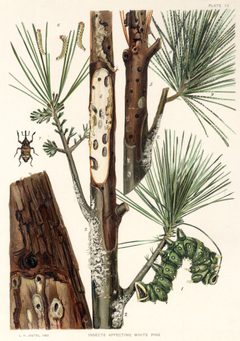
feed on needles and terminals (shoots) of pine and spruce trees, creating holes in bark to access vascular tissues. Larvae feed on nutrient-rich phloem, the cambial zone, and outer layers of wood-forming tissue in the shoot leader. This feeding destroys tissues essential for apical growth.
Host Associations
- Pinus strobus - Eastern white pine; preferred native in eastern North America, highly susceptible
- Picea sitchensis - Sitka spruce; primary in Pacific Northwest, young trees particularly susceptible
- Picea glauca - White spruce; documented , leaders least suitable for production
- Picea engelmannii - Engelmann spruce; documented
- Pinus spp. - Various pine including Scots, red, pitch, jack, and Austrian pines
- Picea spp. - Various spruce including Colorado blue, Norway, and Serbian spruces
Life Cycle
are laid in the phloem tissue of the shoot leader. Larvae hatch in approximately one week and feed on phloem, cambium, and outer wood tissues. Larval feeding destroys the vascular tissues essential for apical growth, causing wilting and potential death of the infested stem section. Development from egg to occurs within a single growing season, with adults maturing by late summer. Adults overwinter in forest floor duff. Some females store fertilized eggs through winter, allowing oviposition in spring without requiring breeding within that period.
Behavior
exhibit selection , with deterrence observed on tree . Mating occurs on host tree stem sections; mating behavior is also deterred on resistant trees. Movement patterns tracked via radioactive cobalt labeling show preference for susceptible trees in choice experiments. Females create feeding punctures in bark, with higher numbers of punctures observed during night hours than day hours. Oviposition occurs during both photophase and scotophase without significant difference.
Ecological Role
Native forest insect pest causing growth losses, stem deformation, and potential mortality in young conifers. Damage can kill stem sections and prevent new growth from the shoot tip, causing lateral branches to assume apical dominance. The is sufficiently damaging that Sitka spruce is no longer commercially planted in substantial numbers in its natural range. Some tree possess genetic resistance that disrupts weevil , representing a coevolutionary dynamic.
Human Relevance
Significant economic pest of forestry and Christmas tree plantations. Damage reduces timber quality and tree form, causing economic losses. Management has historically relied on repeated applications, with concerns about non-target effects. Research focuses on identifying and breeding tree , understanding resistance mechanisms, and evaluating agents. The has been reared on modified artificial diets for laboratory studies.
Similar Taxa
- Pissodes spp.Other in the share similar and conifer-feeding habits; identification to species level requires careful examination and may depend on association and geographic origin
- Other conifer-feeding weevilsSimilar damage on terminal leaders; P. strobi distinguished by specific associations, geographic range, and coloration with white spots
More Details
Host specificity and geographic variation
Western reared on Sitka spruce are genetically unable to utilize eastern white pine, even under forced conditions. This unacceptability is genetically controlled rather than influenced by prior experience. Population genetic studies using found significant frequency differences between weevil populations on different host within 2 km of each other, suggesting potential for host specialization and small breeding populations.
Host resistance mechanisms
Sitka spruce deter weevil selection and mating, delay or reduce female ovary development, and prevent successful . Resistant white spruce shows different terpenoid composition in wound resin compared to susceptible trees. In coastal British Columbia, resistant Sitka spruce disrupts and larva development, deters host selection and mating, and delays ovary development in female weevils.
Reproductive biology details
Mean is 132.3 per female (range 40–344) over an average oviposition period of 5.8 weeks. Peak egg-laying occurs in the second week. Some females continue egg production up to 22 weeks. Two-year-old females show similar oviposition and feeding patterns to one-year-old females.
Sources and further reading
- BugGuide
- Wikipedia
- GBIF taxonomy match
- iNaturalist taxon
- NCBI Taxonomy
- Catalogue of Life
- Got a Question About Butterflies? | Bug Squad
- This Artificial Diet May Make Insect Rearing Easier
- Aphids serve a tasty autumn treat: White pine aphid, Cinara strobi — Bug of the Week
- Clubmoss along the Ozark Trail | Beetles In The Bush
- I don’t think you’re ready for these Jellies: A brief dive into the world of Jellyfish - Buglife Blog - Buglife
- IMA Fungus publishes its first issue with Pensoft
- Pissodes strobi . [Distribution map].
- Parasitoids of European Species of the Genus Pissodes (Col: Curculionidae) and Their Potential for the Biological Control of Pissodes strobi (Peck) in Canada
- Behavioral and Reproductive Response of White Pine Weevil (Pissodes strobi) to Resistant and Susceptible Sitka Spruce (Picea sitchensis)
- The Survival of Adults of the White Pine Weevil, Pissodes strobi (Peck), Labelled with Radioactive Cobalt
- Sexual Reproduction in the White Pine Weevil (Pissodes strobi [Peck] [Coleoptera: Curculionidae]): Implications for Population Genetic Diversity
- Genetic resistance of Sitka spruce (Picea sitchensis) populations to the white pine weevil (Pissodes strobi): distribution of resistance
- HOST SPECIFICITY IN PISSODES STROBI (COLEOPTERA: CURCULIONIDAE): ROLES OF GEOGRAPHY, GENETICS, AND BEHAVIOR
- REPRODUCTIVE EFFECTS OF INSECT GROWTH REGULATORS ON THE WHITE PINE WEEVIL, PISSODES STROBI (COLEOPTERA: CURCULIONIDAE)
- Oviposition biology of Pissodes strobi (Coleoptera: Curculionidae) on white pine (Pinaceae) under laboratory conditions
- Biology ofCoeloides sordidator(Hymenoptera: Braconidae), a Possible Candidate for Introduction AgainstPissodes strobi(Coleoptera: Curculionidae) in North America
- LEVELS OF SITKA SPRUCE WEEVIL, PISSODES STROBI (PECK), DAMAGE AMONG SITKA SPRUCE PROVENANCES AND FAMILIES NEAR SAYWARD, BRITISH COLUMBIA
- WHITE PINE WEEVIL, PISSODES STROBI (COLEOPTERA: CURCULIONIDAE), ATTACK ON VARIOUS CONIFERS IN NEW YORK
- ASSESSING NATURAL SELECTION IN WHITE PINE WEEVILS (PISSODES STROBI PECK) (COLEOPTERA: CURCULIONIDAE) FOR OVERCOMING RESISTANCE IN TREES: AN EVOLUTIONARY MODEL
- Use of Radioactive Cobalt in Tracing the Movements of the White-Pine Weevil, Pissodes Strobi Peck. (Coleoptera: Curculionidae)