
Dyslobus verrucifer
Casey, 1895
Dyslobus verrucifer is a of broad-nosed weevil in the Curculionidae, Entiminae. It was described by Casey in 1895. The species is known from the Pacific Northwest region of North America, with records from British Columbia south through Washington, Oregon, Idaho, and Montana. Like other members of the tribe Byrsopagini, it is a flightless weevil with a compact, heavily sclerotized body form.
Pronunciation
How to pronounce Dyslobus verrucifer: //dɪsˈloʊbəs vɛˈruːsɪfər//
These audio files are automatically generated. While they are not always 100% accurate, they are a good starting point.
Identification
Distinguished from other Dyslobus by the degree and pattern of tuberculation on the and pronotum; the specific epithet "verrucifer" refers to the wart-like projections. Separation from requires examination of genitalia and detailed sculpturing patterns. The compact body form and elytra separate it from -capable weevils in other . Within the Pacific Northwest, it may be confused with other Byrsopagini such as Byrsopages species, but Dyslobus generally shows more pronounced tuberculation.
Images
Appearance
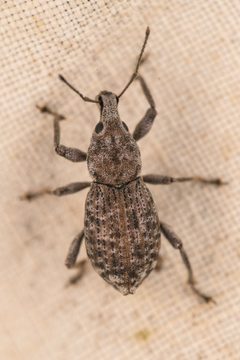
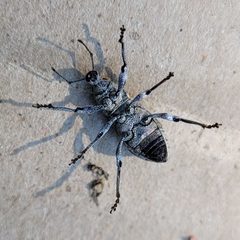
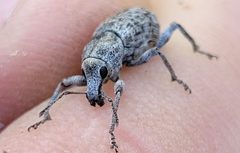
A small to medium-sized broad-nosed weevil. Body compact and robust, with a heavily sculptured, tuberculate or verrucose (wart-like) , consistent with the specific epithet "verrucifer" (wart-bearing). elbowed and clubbed, inserted partway along the rostrum. or nearly fused along the , covering the completely. Legs relatively short and stout, adapted for rather than jumping. Coloration generally dark brown to black, often with a dull, non-reflective .
Habitat
Found in forested and montane environments of the Pacific Northwest. Specific microhabitat preferences are poorly documented, but related in Byrsopagini are typically associated with ground-layer vegetation, leaf litter, and soil surface in coniferous or mixed forests.
Distribution
Pacific Northwest of North America: British Columbia (Canada), and the United States states of Washington, Oregon, Idaho, and Montana.
Seasonality
activity period not well documented; likely active during warmer months based on general patterns for temperate Entiminae.
Behavior
As a member of flightless Entiminae, individuals move by and are likely slow-moving, cryptic inhabitants of ground-layer . or activity patterns probable but not confirmed.
Ecological Role
Likely functions as a or herbivore in forest floor ; specific ecological role not documented.
Human Relevance
No known economic or agricultural significance; not documented as a pest .
Similar Taxa
- Dyslobus other species share compact body form and flightless condition; require detailed examination of tuberculation patterns and male genitalia for separation.
- Byrsopages speciesSympatric members of tribe Byrsopagini; generally less tuberculate dorsally and may show different body proportions.
- Other Entiminae generaFlightless condition and body form overlap broadly; rostral structure and antennal insertion points differ among .
More Details
Taxonomic history
Described by Thomas L. Casey in 1895, a prolific describer of North American Coleoptera. The Dyslobus was established by LeConte in 1876 and currently contains approximately 15 , all restricted to western North America.
Flightlessness
Fusion of and absence of functional hindwings is characteristic of Byrsopagini and many Entiminae, representing an evolutionary to stable ground-dwelling with reduced capacity.