
Sciaphilus asperatus
(Bonsdorff, 1785)
Scaly strawberry weevil, Strawberry root weevil
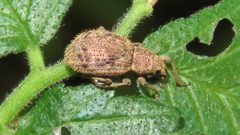
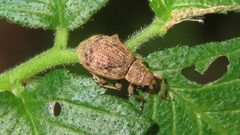
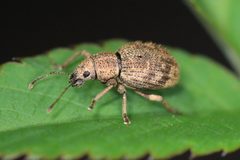
A wingless, parthenogenetic weevil with a broad Palaearctic distribution, recently introduced to North America. feed on leaves of diverse plants, producing distinctive notched edges, while larvae develop underground on roots. The exhibits high reproductive output and can form locally abundant .
Pronunciation
How to pronounce Sciaphilus asperatus: //skaɪˈæfɪləs æˈspɛrətəs//
These audio files are automatically generated. While they are not always 100% accurate, they are a good starting point.
Identification
Wingless with characteristic notched feeding damage on leaf margins. Distinguished from similar weevils by the combination of winglessness, parthenogenetic , and association with moist, shaded . Larvae possess six instars with specific morphological characters detailed in taxonomic keys.
Images
Habitat
Moist, shaded environments including forests, river banks, bushes, grassland, parks, gardens, and agricultural cultivations.
Distribution
Native to Western Palaearctic, Central Asia (Kazakhstan), and western Siberia (Tomsk region). Introduced to North America with records from Alberta, British Columbia, and the Great Lakes region. First recorded in Turkey in 2019.
Seasonality
active from mid-April to early October. Oviposition occurs from late April through July, with some individuals producing a second batch in August-September after a pre-oviposition period. Larval development in spring and summer; June-August lasting 14-21 days. Overwinters as adults.
Diet
are leaf feeders on herbs, shrubs, and trees. Larvae feed on roots, particularly of strawberry (Fragaria), cinquefoil (Potentilla), raspberry and blackberry (Rubus), hawthorn (Crataegus), primrose (Primula), and various ornamental plants including Astilbe, Tiarella, Epimedium, small Rhododendron , and Weigela florida.
Host Associations
- Fragaria - larval strawberry
- Potentilla - larval cinquefoil
- Rubus - larval raspberry, blackberry
- Crataegus - larval hawthorn
- Primula - larval primrose
- Astilbe - larval
- Tiarella - larval
- Epimedium - larval
- Rhododendron - larval small
- Weigela florida - larval and
- Waldsteinia geoides - larval
Life Cycle
Six larval instars confirmed. laid in batches of 6-157 eggs, glued with secretion between overlapping leaves, leaf folds, petioles, or stems near ground level. Single females produce 450-700 eggs in wild , with laboratory records up to 880-1000 eggs annually. Developmental timing varies with spring-emerging ovipositing after 12 days versus late-summer adults requiring 24-31 days pre-oviposition.
Behavior
feeding produces characteristic notched leaf edges. Parthenogenetic enables rapid establishment. Winglessness restricts to , contributing to localized population buildup.
Ecological Role
Minor economic pest in strawberry and ornamental plantings. Comprised nearly 10% of soil-dwelling weevil larvae in North American forest soil studies. Contributes to belowground herbivore diversity in shaded, moist .
Human Relevance
Occasional pest in strawberry and ornamental nurseries. Economic impact generally low but can reach damaging levels in favorable conditions.
Similar Taxa
- Otiorhynchus spp.Other wingless parthenogenetic Entiminae weevils; distinguished by larval and feeding damage patterns
- Sciaphilus muricatus with overlapping distribution; requires examination of genitalia or larval characters for definitive separation
Sources and further reading
- BugGuide
- Wikipedia
- GBIF taxonomy match
- iNaturalist taxon
- NCBI Taxonomy
- Catalogue of Life
- Very wary tigers! | Beetles In The Bush
- Sciaphilus asperatus (Bonsdorff, 1785) (Coleoptera: Curculionidae): First Record for Turkey and Data on its General Distribution
- Descriptions of the mature larva and pupa of the Scaly strawberry weevil, Sciaphilus asperatus (Bonsdorff, 1785) (Coleoptera, Curculionidae, Entiminae) and observations of its biology
- Figure 4 from: Gosik R, Sprick P, Tiahunova T (2019) Descriptions of the mature larva and pupa of the Scaly strawberry weevil, Sciaphilus asperatus (Bonsdorff, 1785) (Coleoptera, Curculionidae, Entiminae) and observations of its biology. ZooKeys 873: 65-83. https://doi.org/10.3897/zookeys.873.35922
- Figures 23-26 from: Gosik R, Sprick P, Tiahunova T (2019) Descriptions of the mature larva and pupa of the Scaly strawberry weevil, Sciaphilus asperatus (Bonsdorff, 1785) (Coleoptera, Curculionidae, Entiminae) and observations of its biology. ZooKeys 873: 65-83. https://doi.org/10.3897/zookeys.873.35922
- Figures 1-3 from: Gosik R, Sprick P, Tiahunova T (2019) Descriptions of the mature larva and pupa of the Scaly strawberry weevil, Sciaphilus asperatus (Bonsdorff, 1785) (Coleoptera, Curculionidae, Entiminae) and observations of its biology. ZooKeys 873: 65-83. https://doi.org/10.3897/zookeys.873.35922
- Figures 12-19 from: Gosik R, Sprick P, Tiahunova T (2019) Descriptions of the mature larva and pupa of the Scaly strawberry weevil, Sciaphilus asperatus (Bonsdorff, 1785) (Coleoptera, Curculionidae, Entiminae) and observations of its biology. ZooKeys 873: 65-83. https://doi.org/10.3897/zookeys.873.35922
- Figure 10- 11 from: Gosik R, Sprick P, Tiahunova T (2019) Descriptions of the mature larva and pupa of the Scaly strawberry weevil, Sciaphilus asperatus (Bonsdorff, 1785) (Coleoptera, Curculionidae, Entiminae) and observations of its biology. ZooKeys 873: 65-83. https://doi.org/10.3897/zookeys.873.35922
- Figures 20-22 from: Gosik R, Sprick P, Tiahunova T (2019) Descriptions of the mature larva and pupa of the Scaly strawberry weevil, Sciaphilus asperatus (Bonsdorff, 1785) (Coleoptera, Curculionidae, Entiminae) and observations of its biology. ZooKeys 873: 65-83. https://doi.org/10.3897/zookeys.873.35922
- Figures 5-9 from: Gosik R, Sprick P, Tiahunova T (2019) Descriptions of the mature larva and pupa of the Scaly strawberry weevil, Sciaphilus asperatus (Bonsdorff, 1785) (Coleoptera, Curculionidae, Entiminae) and observations of its biology. ZooKeys 873: 65-83. https://doi.org/10.3897/zookeys.873.35922