
Brachyderes incanus
(Linnaeus, 1758)
Pine Weevil, White Pine Weevil
Brachyderes incanus is a weevil in the Curculionidae. are primarily associated with coniferous trees, particularly pines. The species has a broad distribution across parts of Europe and Asia. Larval development occurs in roots and root collars of trees, where feeding damage can be significant.
Pronunciation
How to pronounce Brachyderes incanus: //ˌbrækɪˈdɪəriːz ɪnˈkeɪnəs//
These audio files are automatically generated. While they are not always 100% accurate, they are a good starting point.
Identification
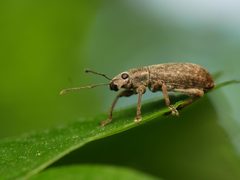
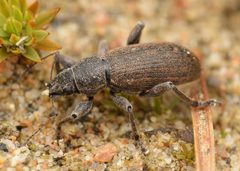
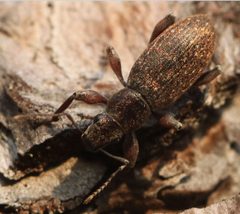
Distinguished from other Brachyderes by the uniformly dull, greyish coloration without prominent patterning. B. incanus lacks the distinct pale bands or spots seen in some . The rostrum is shorter than in , a similar pine-associated weevil. may be confused with Pissodes species, but Brachyderes has a broader, less cylindrical body and shorter rostrum.
Images
Appearance
Medium-sized weevil with a compact, oval body. Body coloration ranges from greyish-brown to nearly black, often with a faintly lighter, dusty or 'hoary' appearance (reflecting the specific epithet 'incanus', meaning 'greyish-white'). The rostrum is relatively short and stout compared to many other weevils. are elbowed and clubbed, arising about midway along the rostrum. are striated with distinct puncture rows. Body length approximately 8–12 mm.
Habitat
Coniferous forests, particularly pine stands (Pinus spp.). Found in both natural woodlands and commercial plantations. occur on trees and in surrounding soil and litter. Larvae develop in roots and root collars, requiring moist soil conditions.
Distribution
Europe: widespread including Scandinavia, Baltic region (Kaliningrad, Kirov), and Iberian Peninsula (Cádiz). Asia: recorded from China (Guizhou, Hebei). Absent from North America.
Seasonality
active from spring through autumn, with peak activity in late spring and early summer. Larval development occurs primarily in summer months. typically as adults in soil or litter.
Diet
feed on bark, needles, and shoots of conifers, primarily Pinus . Larvae feed on roots and root collars of the same . Has been observed feeding on Picea and Larix when pine is unavailable.
Host Associations
- Pinus - primary feeding and larval development
- Picea - secondary occasional feeding
- Larix - secondary occasional feeding
Life Cycle
Complete . laid in soil near tree roots. Larvae feed on roots and root collar for 1–2 years, with development rate depending on temperature and host condition. occurs in soil. emerge and may feed on host foliage before seeking sites. time typically 1–2 years.
Behavior
are primarily , hiding in soil or litter during daylight. When disturbed, adults drop from vegetation and feign death (). Limited capability; occurs mainly by . Adults aggregate on stressed or recently felled trees.
Ecological Role
Primary consumer in coniferous forest . Larval root feeding can accelerate decline of stressed or damaged trees. Contributes to nutrient cycling through herbivory and subsequent decomposition of damaged plant material. Serves as prey for ground-foraging birds and insectivorous mammals.
Human Relevance
Forestry pest of minor to moderate importance. Larval feeding on root collars can kill or stunt young pine transplants and seedlings. feeding on bark and shoots causes limited damage. Management in nurseries and plantations may involve treatment of soil or use of physical barriers. Not a household or stored product pest.
Similar Taxa
- Hylobius abietisLarger size (10–14 mm), longer rostrum, more active , and preference for stumps and fresh cuttings rather than living root collars.
- Pissodes piniMore cylindrical body, longer with looser club, and association with cones and upper trunk rather than roots.
- Brachyderes lusitanicusRestricted to Iberian Peninsula and North Africa; have more distinct patterning and less uniform grey coloration.