
Anthonomini
Thomson, 1859
Genus Guides
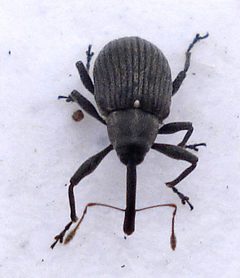
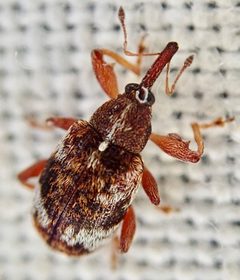
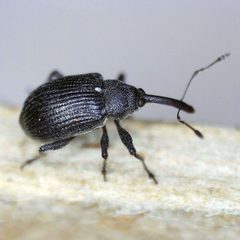
18Anthonomini is a tribe of weevils within the Curculioninae, comprising approximately 40 including Anthonomus, the type genus. Members are primarily herbivorous weevils, with many exhibiting specific plant associations. The tribe includes economically significant pests such as the boll weevil (Anthonomus grandis) and several species associated with Malvaceae, Rosaceae, and other plant . Species are distributed across multiple continents, with documented occurrences in the Neotropics, Nearctic, Palearctic, and Oriental regions.
Pronunciation
How to pronounce Anthonomini: /ænˈθɒnəˌmaɪni/
These audio files are automatically generated. While they are not always 100% accurate, they are a good starting point.
Identification
Anthonomini can be distinguished from related tribes in Curculioninae by the following combination of characters: antennal funicle typically with seven antennomeres; pronotum often with distinctive projection at middle; with either distinct or effaced; tarsal claws usually with small basal tooth; and frequently armed with teeth (profemora often with two teeth, meso- and metafemora with one). The Anthonomus, which contains the majority of , is characterized by a compact body form and rostrum with distinct patterns in many species groups.
Images
Habitat
Tropical semideciduous forest; temperate regions. Specific preferences vary by and . Anthonomus brunnipennis has been documented in two distinct habitat types in Germany. Many species show strong association with specific plants, including forest understory and open vegetation .
Distribution
Widespread across multiple biogeographic regions: Neotropical (Guatemala, Honduras, Mexico, Cuba), Nearctic, Palearctic (Germany), and Oriental (China). The tribe contains both widespread and geographically restricted ; Cubanthonomus is to Cuba.
Diet
Herbivorous. Larval and feeding occurs on plant material. Anthonomus brunnipennis is documented feeding on Potentilla erecta (Rosaceae). Anthonomus petrus is associated with Heliocarpus and Triumfetta (Tiliaceae/Malvaceae). Many Anthonomus are known to feed on Malvaceae, including cotton and related plants.
Host Associations
- Potentilla erecta - only well-documented of Anthonomus brunnipennis
- Heliocarpus - of Anthonomus petrus
- Triumfetta - of Anthonomus petrus
- Gossypium - of economically significant pest including Anthonomus grandis
Life Cycle
Complete with , larva, pupa, and stages. Larvae and pupae of Anthonomus brunnipennis have been described; stages show -specific diagnostic characters that distinguish them from closely related species such as A. rubi. Developmental varies by species and is closely tied to plant .
Ecological Role
Herbivores that influence plant through feeding damage to reproductive structures (flower buds, fruits) and vegetative tissues. Some act as specialized herbivores with narrow ranges, potentially contributing to plant structure.
Human Relevance
Contains significant agricultural pests, most notably Anthonomus grandis (boll weevil), which caused major economic damage to cotton production in the Americas. Some are used as agents against plants. Taxonomic study of the tribe is active due to economic importance and biodiversity documentation needs.
Similar Taxa
- CleogoniniPreviously confused with Anthonomini; Cubanthonomus was transferred from Cleogonini (where it was placed as incertae sedis) to Anthonomini based on morphological characters including antennal funicle structure and tarsal claw .
- Anthonomus rubi are morphologically similar to A. brunnipennis but stages are diagnostically distinct; proper identification requires examination of larvae or pupae.
More Details
Taxonomic composition
The tribe contains approximately 40 including Acalyptops, Achia, Adelus, Anthonomopsis, Anthonomus, Atractomerus, Botanebius, Brachonyx, Bradybatus, Chelonychus, Cionesthes, Cionomimus, Cionopsis, Coccotorus, Cremastorhynchus, Cubanthonomus, Dietzianus, Ephelops, Epimechus, Huaca, Lepidoops, Lonchophorellus, Loncophorus, Macrobrachonyx, Magdalinops, Melexeras, Nanops, Narberdia, Neomastix, Neosphinctocraerus, Omogonus, Onychoenemis, Parendoeopsis, Phacellopterus, Pseudanthonomus, Pseudopoophagus, Smicraulax, Sphincticraerus, Synnadophila, and Telphasia.
Research gaps
associations remain unknown for many , including Cubanthonomus. and stage descriptions are available for only a small fraction of . Ecological and behavioral data are sparse for most .
Sources and further reading
- BugGuide
- Wikipedia
- GBIF taxonomy match
- iNaturalist taxon
- NCBI Taxonomy
- Cubanthonomus, a new genus of Anthonomini (Coleoptera: Curculionidae: Curculioninae) from Cuba
- Revision of the subgenus Persexarthrus Voss of the genus Anthonomus Germar (Coleoptera: Curculionidae: Anthonomini)
- A new species of Anthonomus (Coleoptera: Curculioninae: Anthonomini) in the Anthonomus squamosus species group associated with Tiliaceae (Malvales)
- Description of the immature stages and bionomics of Anthonomus (Anthonomus) brunnipennis Curtis, 1840 (Coleoptera, Curculionidae, Anthonomini)
- The complete mitochondrial genome of Coccotorusbeijingensis Lin et Li, 1990 (Coleoptera, Curculionidae, Curculioninae, Anthonomini) and its phylogenetic implications.