
Pentarthrum huttoni
Wollaston, T.V., 1854
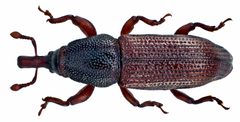
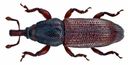
Pentarthrum huttoni is a wood-boring weevil in the Curculionidae. It has been documented causing damage to historic wooden structures, notably 18th-century softwood coffins in Vienna. The exhibits a primarily Nearctic distribution but has established in several European countries.
Pronunciation
How to pronounce Pentarthrum huttoni: //pɛnˈtarθrəm ˈhʌtənaɪ//
These audio files are automatically generated. While they are not always 100% accurate, they are a good starting point.
Identification
As a member of the Pentarthrum, this can be distinguished from other wood-boring weevils by its association with extremely high humidity environments and pre-decayed softwood substrates. Specific diagnostic morphological features for separating P. huttoni from congeneric species are not provided in available sources.
Images
Habitat
Found in environments with extremely high humidity (100% relative humidity). Attacks wood that is already in a state of decay or rot. In Central Europe, most records originate from indoor building environments rather than natural forest settings.
Distribution
Primarily Nearctic in native range. Introduced and established in Europe, with confirmed records from Austria (first reported 2006), Belgium, and potentially other European countries. The Austrian was discovered in the crypt of St. Michael's Church in Vienna.
Diet
Feeds on softwood that is already rotting or in advanced stages of decay. Does not attack sound, dry wood.
Host Associations
- softwood - substratepre-decayed wood
- historic wooden coffins - substratedocumented case in Vienna crypt
Ecological Role
Decomposer of decaying wood in high-humidity environments. In artificial settings, contributes to the disintegration of wooden structural elements and historic artifacts.
Human Relevance
Recognized as a pest of historic wooden structures. Caused significant damage to 18th-century softwood coffins in St. Michael's Church, Vienna, leading to structural disintegration of culturally significant artifacts. Most Central European records are associated with buildings rather than natural .
Similar Taxa
- other Pentarthrum speciescongeneric wood-boring weevils with similar ecological preferences; specific identification requires detailed morphological examination
- other wood-boring Curculionidaeshare wood-boring habit but differ in humidity requirements and substrate condition preferences
More Details
Historic Damage Case
The 2006 discovery in Vienna represents a significant documented case of this causing damage to cultural heritage materials. The in the church crypt demonstrates the species' ability to persist and cause damage in stable, high-humidity artificial environments over extended periods.