
Madarellus undulatus
(Say, 1824)
Wavy Flower Weevil
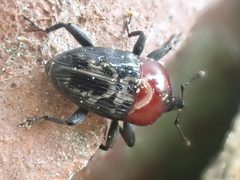
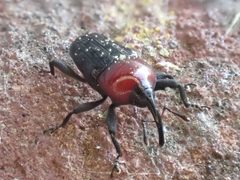
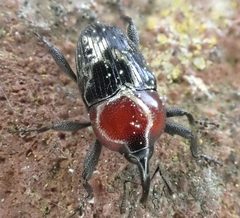
Madarellus undulatus is a small weevil in the Curculionidae, Baridinae. It measures 2.8–4.5 mm in length and exhibits distinctive coloration with a brown and black or sometimes reddish body. The species is widely distributed across North America, occurring throughout the United States and in the Canadian provinces of Ontario and Quebec. Larvae have been documented feeding on poison ivy (Toxicodendron radicans) and Virginia creeper (Parthenocissus quinquefolia).
Pronunciation
How to pronounce Madarellus undulatus: /məˈdæɹələs ˌʌndjʊˈleɪtəs/
These audio files are automatically generated. While they are not always 100% accurate, they are a good starting point.
Identification
Distinguished from other small weevils by the combination of brown with black or reddish body, and somewhat punctate prothorax, and . The specific epithet 'undulatus' refers to the wavy appearance, likely of the elytral or overall body contour. Similar in the Madarellus and related Baridinae would require examination of genitalia or other fine structural details for definitive separation.
Images
Appearance
Small weevil measuring 2.8–4.5 mm in length. is brown in color. Body is black or sometimes reddish. Prothorax is and somewhat punctate. are (marked with fine longitudinal grooves or lines).
Distribution
Occurs throughout the United States and in Canada (Ontario and Quebec). GBIF records also indicate presence in Nova Scotia and Vermont.
Diet
Larvae feed on poison ivy (Toxicodendron radicans) and Virginia creeper (Parthenocissus quinquefolia). feeding habits are not documented.
Host Associations
- Toxicodendron radicans - larval food plantpoison ivy
- Parthenocissus quinquefolia - larval food plantVirginia creeper
Similar Taxa
- Other Madarellus speciesSame , require detailed examination for separation
- Other Baridinae weevilsSimilar small size and general weevil , distinguished by specific color pattern and
More Details
Taxonomic history
First described by Thomas Say in 1824, making it one of the earlier described North American weevil .
Nomenclature
The specific epithet 'undulatus' (Latin for wavy or undulating) likely refers to the wavy appearance of the elytral or body outline.
Sources and further reading
- BugGuide
- Wikipedia
- GBIF taxonomy match
- iNaturalist taxon
- NCBI Taxonomy
- Catalogue of Life
- Wyoming Distribution Atlas
- Grasshopper Collections and Survey
- Wrong lens | Beetles In The Bush
- “Rare jewel beetles discovered in Mexico by team of scientists!” | Beetles In The Bush
- June | 2011 | Beetles In The Bush | Page 2
- herpetology | Beetles In The Bush | Page 2