
Cerobates
Schoenherr, 1840
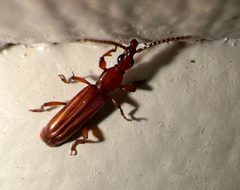
Cerobates is a of straight-snouted weevils in the Brentidae, established by Schoenherr in 1840. The genus contains at least eight described distributed across tropical regions. Brentidae are characterized by their elongated, cylindrical bodies and straight rostrums, distinguishing them from the more familiar curved-snouted weevils of Curculionidae.
Pronunciation
How to pronounce Cerobates: /sɛˈroʊbeɪtiːz/
These audio files are automatically generated. While they are not always 100% accurate, they are a good starting point.
Identification
Members of Cerobates can be distinguished from other brentid by the combination of a straight, elongated rostrum and cylindrical body form. The genus lacks the geniculate (elbowed) typical of Curculionidae weevils. Specific -level diagnostic features require examination of subtle morphological characters such as elytral striation patterns and body proportions.
Images
Distribution
of Cerobates have been recorded from tropical regions of the Old World, including Southeast Asia (Enggano Island, source of C. enganoënsis) and other Indo-Pacific localities. The appears to be primarily Oriental in distribution, though precise range boundaries for most species remain undocumented.
Similar Taxa
- Brentidae (family)Cerobates is distinguished from other brentid by subtle morphological characters; many brentid genera share the 's characteristic straight rostrum and require careful examination for proper identification.
- Curculionidae (family)Cerobates and other Brentidae are frequently confused with true weevils due to similar overall body plan, but differ fundamentally in having straight rather than geniculate and a straight rather than curved rostrum.
More Details
Taxonomic Note
There is taxonomic ambiguity regarding the rank of Cerobates. Catalogue of Life treats it as a subgenus, while GBIF, NCBI, and most other sources recognize it as a . This discrepancy reflects ongoing revisions within Brentidae classification.
Species Diversity
Eight are currently recognized: C. elegans, C. enganoënsis, C. fleutiauxi, C. pidigala, C. pygmaeus, C. sennae, C. sulcatus, and C. tristriatus. The etymology of specific epithets suggests historical collections from diverse localities, though comprehensive revisionary work is lacking.