
Cylas formicarius
(Fabricius, 1798)
Sweet Potato Weevil
Cylas formicarius is a globally significant pest of sweet potato (Ipomoea batatas), causing 30-100% yield losses in over 80 countries. The exhibits a highly cryptic lifestyle: larvae feed internally within vines and tubers, making chemical control ineffective once occurs. are and migratory, with in structure. The weevil has been designated a pest worldwide due to its economic impact on food security and agricultural trade.
Pronunciation
How to pronounce Cylas formicarius: /ˈsaɪləs fɔrˌmɪˈkɛəriəs/
These audio files are automatically generated. While they are not always 100% accurate, they are a good starting point.
Identification
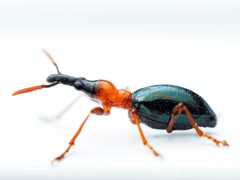
Distinguished from other Cylas by male structure ( vs. variations in related species) and composition (Z-3-dodecenyl-E-2-butenoate). Resembles ants in general form due to constricted body shape, hence specific epithet 'formicarius.' Larval presence confirmed by examination of vines and tubers for feeding galleries, tissue swelling, and accumulation. may be detected by pheromone trapping; red traps effective in field conditions, green traps effective indoors.
Images
Habitat
Tropical and subtropical agricultural regions where sweet potatoes are cultivated. Thrives in sandy soils and drought-prone conditions. Year-round activity in tropical zones; seasonal activity in temperate regions. Associated with both field-grown and stored sweet potato crops.
Distribution
distribution spanning Africa, Australia, Caribbean, Central America, Europe and Northern Asia (excluding China), North America (southeastern USA, Hawaii, Mexico), Oceania, South America, and Southern Asia. Present in more than 80 of 109 sweet potato cultivating countries. Major production areas affected include China, Malawi, Nigeria, Tanzania, Uganda, and Indonesia. Subject to regulations in multiple jurisdictions.
Seasonality
Year-round activity in tropical and subtropical regions. In temperate zones, activity corresponds with growing season. longevity 93-95 days under favorable conditions. Complete approximately 31.9 days at 27-30°C.
Diet
feed externally on leaves, petioles, stems, and create circular feeding punctures on tuber surfaces. Larvae and pupae feed internally within vines and tubers, consuming vascular tissues and inducing terpenoid phytoalexin synthesis that renders tubers unpalatable.
Host Associations
- Ipomoea batatas - primary Sweet potato; main cultivated worldwide. Damage occurs to vines and storage roots.
Life Cycle
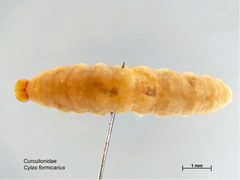
Holometabolous with four stages: , larva, pupa, . Eggs deposited in shallow cavities on tuber surfaces or vine tissues, sealed with . Larvae undergo endophytic feeding within tissues, creating galleries. occurs within feeding tunnels. Adult through exit holes. time approximately 31.9 days at 27-30°C. Adult longevity 93-95 days.
Behavior
activity. Highly cryptic: larvae concealed within plant tissues, adults often hidden in soil cracks or plant debris during daylight. Females exhibit precise oviposition , sealing chambers with to maintain humidity and reduce . Adults migratory, requiring repeated applications in management programs. Larval feeding induces defensive terpenoid phytoalexin production in tubers. Vine damage positively correlated with tuber damage, indicating patterns.
Ecological Role
Major agricultural pest with no documented beneficial functions. Threatens global food security through destruction of sweet potato crops valued as food, animal feed, biofuel source, and industrial raw material. Economic losses exceed $7 million annually in the southern United States alone. Serves as target organism for research involving fungi ( bassiana) and .
Human Relevance
Subject to international regulations due to high destructive potential and difficulty of . Infested tubers unmarketable due to tissue damage, bitter taste from terpenoid compounds, and presence of . Management relies on combining varieties, crop , trapping, agents, and selective chemical applications. Research focus for development of sustainable control methods including transgenic resistance and improved trapping technologies.
Similar Taxa
- Cylas brunneusAfrican sweet potato weevil; distinguished by male (dodecyl-E-2-butenoate) and antennal structure. Some pheromone cross-attraction documented at high concentrations.
- Cylas puncticollisWest African sweet potato weevil; distinguished by male (decyl-E-2-butenoate) and geographic distribution. Smaller body size and different pheromone precursor alcohol (decan-1-ol).
More Details
Pheromone Biology
Male-produced (Z)-3-dodecenyl-(E)-2-butenoate is -specific; free alcohol precursor (3-Z-dodecen-1-ol) can stimulate related species. trapping used for monitoring and mass trapping, though efficacy limited by trap color preferences varying between field (red) and indoor (green) conditions.
Chemical Ecology
location mediated by oxygenated monoterpenes (nerol, Z-citral, methyl geranate) attractive to females; sesquiterpenes (α-gurjunene, α-humulene, ylangene) repellent. Cultivar resistance inversely correlated with sesquiterpene volatile concentration.
Sources and further reading
- BugGuide
- Wikipedia
- GBIF taxonomy match
- iNaturalist taxon
- NCBI Taxonomy
- sweetpotato weevil (Cylas formicarius) - Entomology Today
- Battle Beneath the Vines: Defending Sweet Potatoes From Fearsome Pests
- Are Sweetpotato Weevils Differentially Attracted to Certain Colors?
- The Entomology Profession Archives - Page 92 of 102 - Entomology Today
- Cylas formicarius Archives - Entomology Today
- Cylas formicarius . [Distribution map].
- Cylas formicarius . [Distribution map].
- Recent Advances in Sustainable Management of Cylas formicarius
- Sweetpotato Weevil, Cylas formicarius (Fabricius) (Insecta: Coleoptera: Brentidae)
- Observations on the Biology of Cylas formicarius Fabricius at Coimbatore
- Sweetpotato weevil pheromones and their precursors: Dose-response and structure activity relationship in Cylas formicarius Fabr., Cylas brunneus Olivier and Cylas puncticollis Boheman
- Influence of Environment and Genotype on the Expression of Host Plant Resistance in Sweet Potato to the Sweet Potato Weevil, Cylas Formicarius (Fab.).
- Temporal and spatial distribution of sweet potato weevils,Cylas formicarius, in the North Carolina sweet potato weevil quarantine area
- Electrophysiological and Behavioural Responses of Sweetpotato Weevil, <i>Cylas formicarius</i> Fab. to Sweetpotato Varieties
- Sweetpotato Volatile Chemistry in Relation to Sweetpotato Weevil (Cylas formicarius) Behavior