
Brentus anchorago
(Linnaeus, 1758)
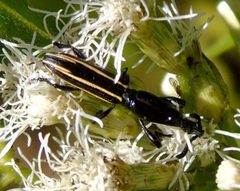
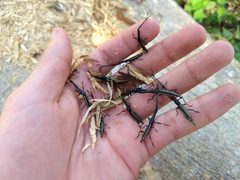
Brentus anchorago is a large, long-snouted weevil in the Brentidae, notable for its extreme size variation (15–52 mm) and pronounced . The is widespread across the Neotropics, ranging from southern Florida through Mexico, the West Indies, and South America. It is closely associated with the gumbo-limbo tree (Bursera simaruba), with larvae boring in dead wood and sometimes found in large under bark.
Pronunciation
How to pronounce Brentus anchorago: //ˈbrɛn.tʊs æŋˈkɔːr.ə.ɡoʊ//
These audio files are automatically generated. While they are not always 100% accurate, they are a good starting point.
Identification
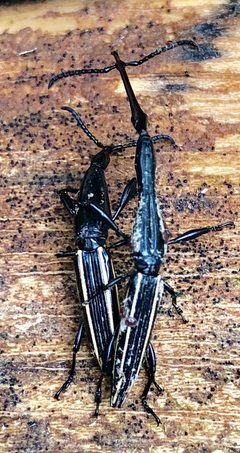
Distinguished from other Brentidae by its large size, extreme length variation, and association with Bursera simaruba. The combination of black coloration with yellow longitudinal elytral markings, non-geniculate serrate , and pronounced in body thickness separates it from similar . Males can be recognized by their slender bodies and shorter, thicker rostrum; females by their more robust bodies and elongated, thin rostrum.
Images
Habitat
Associated with the gumbo-limbo tree (Bursera simaruba) throughout its range. Larvae develop in dead wood, boring into dead trees and logs. are found under bark of dead logs, sometimes in large numbers.
Distribution
Widespread Neotropical ranging from Mexico and the West Indies through South America. In the United States, restricted to Dade and Monroe counties in southern Florida.
Host Associations
- Bursera simaruba - associated withGumbo-limbo tree; larvae bore in dead wood of this
Life Cycle
Larvae bore in dead trees and logs. Developmental details beyond larval are not well documented.
Behavior
aggregate under bark of dead logs. Males exhibit mate-guarding , remaining positioned over females during oviposition. Males use enlarged in combat with other males; territorial disputes between males have been reported to last 10 minutes or more. Females use their elongated rostrum and tiny mandibles to drill holes into wood for insertion.
Ecological Role
Wood-boring decomposer in dead trees; contributes to breakdown of dead Bursera simaruba wood.
Similar Taxa
- Arrhenodes minutusSimilar (Brentidae) and wood-boring , but much smaller (13–35 mm), restricted to eastern North America, and associated with oak (Quercus) rather than Bursera simaruba; lacks the extreme size range of B. anchorago
- Other Brentus speciesCongeneric in southern Florida share similar and , but B. anchorago is distinguished by its larger maximum size and specific association with Bursera simaruba
More Details
Size Variation
The extreme size range (15–52 mm) in is notable and likely reflects variation in larval quality and quantity, a common pattern among wood-boring beetles.
Male Assistance Behavior
Historical reports describe males assisting females in extracting their rostrum if stuck in wood during oviposition by using their body as a lever, though this has not been directly observed in modern studies.