Podapion gallicola
Riley, 1883
Pine Gall Weevil
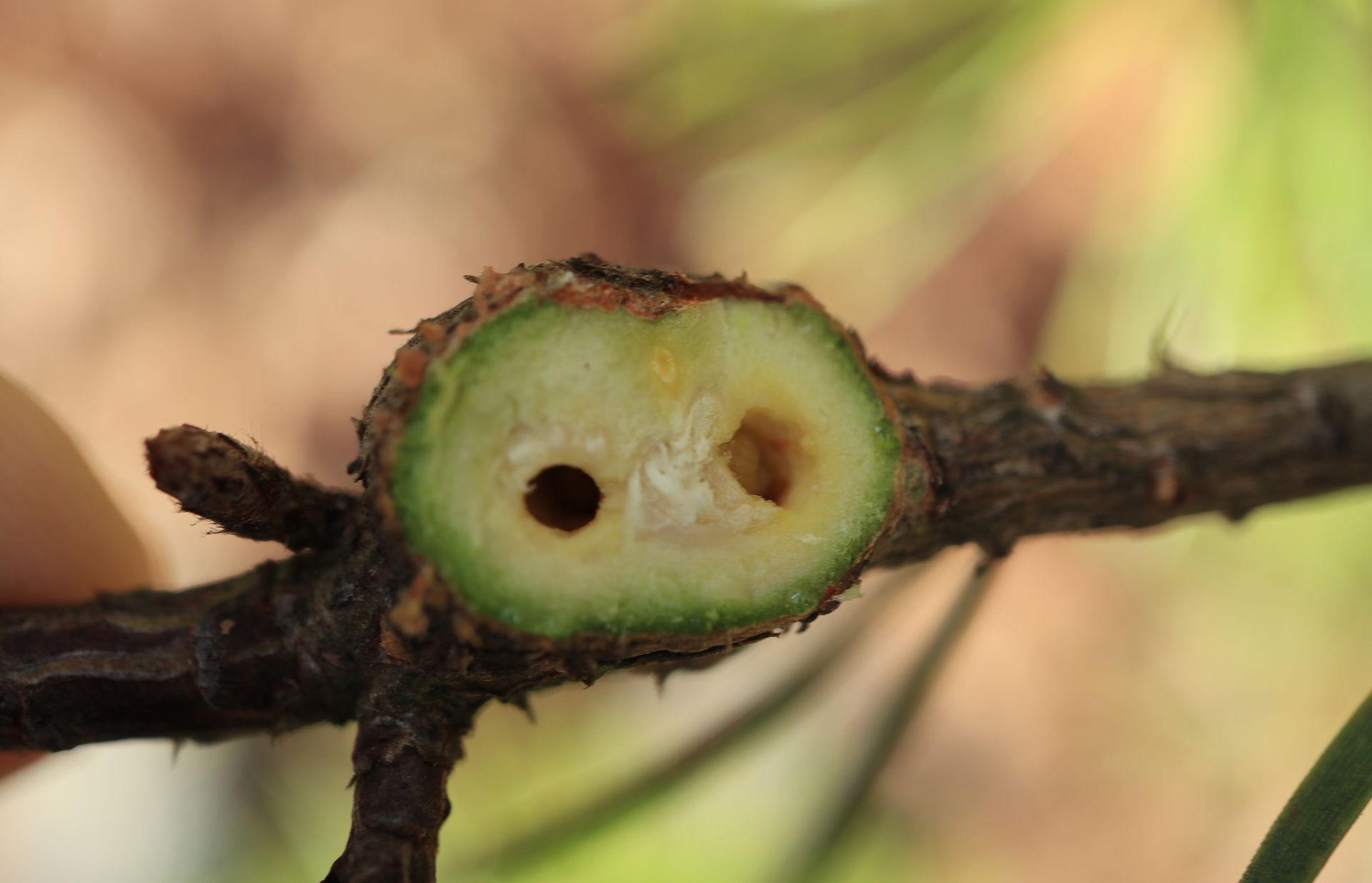
Podapion gallicola is a weevil that induces galls on pine branches. It has a three-year on its tree, with emerging in June and ovipositing through August. Larvae feed gregariously on cambium and xylem tissue, triggering gall formation during their second instar. The is known from Michigan and eastern Canada.
Pronunciation
How to pronounce Podapion gallicola: /poʊˌdæpiˈɒn ˌɡælɪˈkoʊlə/
These audio files are automatically generated. While they are not always 100% accurate, they are a good starting point.
Images
Habitat
Red pine (Pinus resinosa) forests. Larvae develop within galls on pine branches.
Distribution
Michigan, USA; New Brunswick, Ontario, and Quebec, Canada.
Seasonality
active June to August; oviposition June-August. Adult in June following three-year development period.
Diet
Larvae feed on cambium and xylem tissue of red pine (Pinus resinosa).
Host Associations
- Pinus resinosa - Red pine; sole documented in Michigan study
Life Cycle
Three-year cycle. Year 1: laid June-August, larvae emerge August and feed as first instars. Year 2: gall development begins in June when larvae enter second instar. Year 3: third instar begins in June. Year 4: in May, in June. occurs in egg stage or any of three larval instars; adults do not overwinter.
Behavior
chew in bark at branch internodes for oviposition, depositing 1-10 per niche. Larvae initially feed gregariously toward the cambium, then radiate outward along the xylem. Gall induction begins shortly after larvae to second instar.
Ecological Role
Induces gall formation on red pine branches. Acts as a forestry pest of red pine.
Human Relevance
Pest of red pine (Pinus resinosa) in forestry contexts.
More Details
Brood structure
Three distinct occur simultaneously in Michigan , reflecting the overlapping produced by the three-year .
Larval instars
capsule measurements from 1,585 larvae confirm three larval instars.