
Araecerus fasciculatus
(DeGeer, 1775)
Coffee Bean Weevil
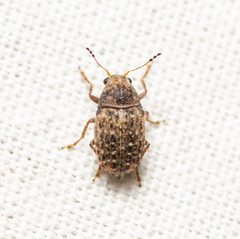
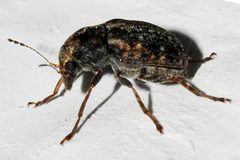
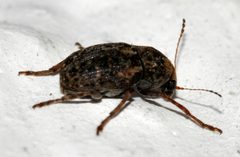
, commonly known as the coffee bean weevil, is a stored product pest in the Anthribidae. measure 3–5 mm with a dome-shaped, dark-brown body mottled with light and dark . The has been documented on over 100 plants including coffee, maize, cassava, nutmeg, dried fruits, and various nuts. It completes its inside seeds and stored products, with development times varying from 29 to 57 days depending on humidity and temperature. Through international trade, it has achieved distribution in tropical and subtropical regions and is considered economically significant due to damage and of stored commodities.
Pronunciation
How to pronounce Araecerus fasciculatus: /ˌær.iˈsi.rəs ˌfæs.ɪˈkjuː.lə.təs/
These audio files are automatically generated. While they are not always 100% accurate, they are a good starting point.
Identification
Distinguished from other Anthribidae by the combination of small size (3–5 mm), dome-shaped body, and with three elongated terminal segments forming a distinct club. The mottled pattern of light and dark brown is characteristic. Similar small weevils in Curculionidae typically have a more elongated rostrum; A. fasciculatus has a short, broad rostrum typical of Anthribidae.
Images
Appearance
Small weevil measuring 3–5 mm in length. Body dome-shaped and robust. Coloration dark-brown with mottled pattern of light and dark brown . slender with three terminal segments elongated and clubbed. are capable fliers.
Habitat
Primarily associated with stored products in warehouses, silos, and food storage facilities. Develops in seeds, dried fruits, tubers, and various stored commodities. In field conditions, has been observed in coffee berries, citrus fruit, and seeds of Melia azedarach. Thrives under high humidity conditions; decline significantly below 60% relative humidity on most substrates.
Distribution
distribution in tropical and subtropical regions worldwide. Documented presence across Africa, Asia, the Americas, Oceania, and Europe. Specific records include: Brazil (coffee plantations), Iran (Melia azedarach seeds), Russia (Yaroslavl Region, southern regions), Indonesia, and various Pacific islands including Galápagos. Spread occurs primarily through international trade of infested commodities.
Seasonality
Multiple overlapping occur throughout the year in suitable conditions. In dried seeds, all motile stages (larvae, pupae, ) can be present simultaneously. Continuous breeding occurs when temperature and humidity remain favorable; no true has been documented.
Diet
Highly . Larval development occurs within seeds and stored products. Documented include: coffee (Coffea spp.), maize (Zea mays), cassava (Manihot esculenta), sweet potatoes, nutmeg, peanuts (Arachis hypogaea), various dried and fresh fruits, Chinese medicinal plant products (Codonopsis pilosula, Ophiopogon japonicus, Astragalus membranaceus, Dendrobium nobile, Angelica dahurica), and seeds of Melia azedarach. feed on the same substrates.
Host Associations
- Zea mays - larval development and feedinghighly preferred variety Pertiwi 3 for oviposition
- Coffea spp. - larval development in seeds; field and stored pestfirst observed inside coffee berry in 2018 using micro-CT
- Manihot esculenta - larval development in tubersdamage primarily to already compromised tubers
- Melia azedarach - larval development in seedsfirst record in Iran; ~25% seed rate
- Arachis hypogaea - larval development and feedingstored peanuts
- Citrus spp. - oviposition in albedo; larval feedingfield pest; necrotic tissue develops around oviposition sites
- Myristica fragrans - larval developmentnutmeg; less suitable food, produces female-biased sex ratio
- Theobroma cacao - larval developmentcacao beans; minimum 80% r.h. required for completion
Life Cycle
Complete . laid on or inserted into seeds or stored products; oviposition takes approximately 8 minutes at 18°C. 3–15 days (average 6.1 days at 28°C, 5–8 days at 27°C). Larvae tunnel into seeds, feeding internally; larval duration varies with humidity (longest at low humidity). occurs inside seeds or commodities. through chewing exit holes. Males sexually mature 3 days after emergence; females 6 days after emergence. occurs at 6 days post-emergence, lasting 6.5–8 minutes. Single fertilization sufficient for full egg . Females lay up to ~50 eggs on stored coffee beans at 28°C. Total : 29 days (maize at 100% r.h., 27°C) to 57 days (maize at 60% r.h., 27°C). Adults live 27–28 days at 50% r.h. to 86–134 days at 90% r.h. on maize.
Behavior
are strong fliers. Oviposition site selection influenced by substrate moisture content (positive correlation with adult presence) and chemical composition (negative correlation with phenol content for -laying). Exhibits olfactory attraction to specific volatile compounds, particularly β-elemene, α-selinene, and β-selinene. Male-produced squalene acts as attracting both sexes. Adults feed on same substrates used for larval development; feeding failure occurs below critical humidity thresholds. Females with delayed show compensatory increased oviposition rate once mated.
Ecological Role
Seed in natural and agricultural . In stored product environments, acts as primary pest causing direct damage through larval tunneling and secondary damage through . Documented yield reductions: up to 39.87% in coffee beans, 91.51% in dried cassava. In field conditions, infests coffee berries, citrus, and various seeds. Serves as prey for predators in storage ecosystems, though specific predator relationships are poorly documented.
Human Relevance
Major economic pest of stored agricultural commodities and food products. Causes direct damage through larval feeding, product , and quality reduction. Significant pest of coffee, maize, cassava, dried fruits, nuts, and medicinal plant products. Management relies on maintaining low humidity and temperature in storage, with phosphine or sulfuryl fluoride, and potential use of -based monitoring traps. No established for coffee or cocoa due to high value and low .
Similar Taxa
- Araecerus coffeaeFormerly considered distinct based on Zimmerman's revision; name confusion resolved with restoration of A. fasciculatus, but historical literature may use either name for the same pest
- Other AnthribidaeDistinguished by the three-segmented antennal club and small dome-shaped body; most other stored product weevils in Curculionidae have elongated rostrums
Misconceptions
Despite the 'coffee bean weevil,' this is not exclusively or primarily a coffee pest; it affects over 100 species and is often more damaging to other commodities such as cassava and maize. The name A. coffeae was historically applied to this species based on a taxonomic revision that was later rejected, causing nomenclatural confusion.
Sources and further reading
- BugGuide
- Wikipedia
- GBIF taxonomy match
- iNaturalist taxon
- NCBI Taxonomy
- Catalogue of Life
- Bug Eric: Spider Sunday: Giant Crab Spider
- Host preference of Araecerus fasciculatus (DeGeer) (Coleoptera: Anthribidae): Adult presence and oviposition on twelve maize varieties
- First record and biology of coffee bean weevil (Araecerus fasciculatus De Geer) on pesticide plant (Melia azedarach L.) from Iran
- First record and biology of coffee bean weevil, Araecerus fasciculatus De Geer, on pesticide plant, Melia azedarach L. from Iran
- Micro-CT to Document the Coffee Bean Weevil, Araecerus fasciculatus (Coleoptera: Anthribidae), Inside Field-Collected Coffee Berries (Coffea canephora)
- On a Finding of the Coffee Bean Weevil Araecerus fasciculatus (De Geer, 1775) (Coleoptera, Anthribidae) in Yaroslavl Region, Russia
- Behavioral responses of Araecerus fasciculatus (Coleoptera: Anthribidae) to volatiles of selected stored Chinese medicinal plant products
- On a Finding of the Polyphagous Pest, Coffee Bean Weevil Araecerus fasciculatus (DeG.) (Coleoptera, Anthribidae), in Natural Habitats of Different Regions of Southern Russia
- ON THE BIOLOGY OF ARAECERUS FASCICULATUS DE GEER (COL., ANTHRIBIDAE), WITH SPECIAL REFFERENCE TO THE EFFECTS OF VARIATIONS IN THE NATURE AND WATER CONTENT OF THE FOOD
- Life Table Parameters and Digestive Enzyme Activity of Araecerus fasciculatus (Coleoptera: Anthribidae) Feeding on Different Stored Products.
- Susceptibility of processed and stored cassava, plantain, yam, and cocoyam to coffee bean weevil (Araecerus fasciculatus De Geer).