
Silvanus recticollis
Reitter, 1876
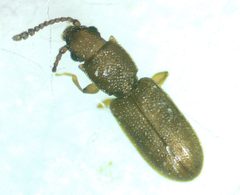
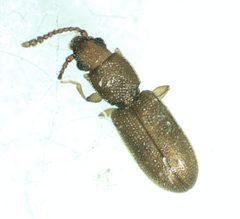
Silvanus recticollis is a small silvan flat bark beetle in the Silvanidae, distributed across Afro-Oriental regions with recent introductions to Europe and North America. are 1.69–2.19 mm in length with an elongated, moderately depressed body form and uniformly yellowish-brown coloration. The has been documented from stored products and natural including forests and woodlands.
Pronunciation
How to pronounce Silvanus recticollis: /sɪlˈvɑːnəs ˌrɛktɪˈkɒlɪs/
These audio files are automatically generated. While they are not always 100% accurate, they are a good starting point.
Identification
Distinguished from other Silvanus by combination of: small size (under 2.2 mm), uniformly yellowish-brown coloration without contrasting patterns, pronotum slightly longer than broad and appearing quadrate, and dense coarse punctation on vertex contrasting with less dense clypeal punctation. The elongated, moderately depressed body form separates it from more convex silvanid .
Images
Habitat
Found in both natural and anthropogenic environments. Natural include dry hilltop forests, post oak woodlands, xeric igneous prairies, and xeric dolomite prairie remnants. Associated with woody vegetation including Sideroxylon lanuginosum (gum bumelia), Quercus spp. (oaks), and various acacias. Also occurs in stored products and facilities handling plant material.
Distribution
Native to Afro-Oriental region: India, Sri Lanka, Vietnam, Laos, Sulawesi, Japan, Thailand, Iriomote Islands, Ethiopia, Mauritania, Congo, Zaire, and Zimbabwe. Introduced to Europe (Poland first recorded 2019; Sardinia, Italy) and North America (Florida, USA).
Host Associations
- Sideroxylon lanuginosum - gum bumelia trees in dry hilltop forests and glades
- Quercus stellata - post oak in xeric prairie remnants
- Quercus havardii - shin oak in sand dune
- Prosopis glandulosa - mesquite in southwestern
- Vachellia constricta - whitethorn acacia
- Juniperus virginiana - eastern red-cedar in glade margins
Human Relevance
Recorded from stored products contexts, indicating potential as a stored product pest. Attracted to ethanol-baited traps used for monitoring cerambycid beetles, suggesting use of fermentation volatiles for location of woody substrates.
Similar Taxa
- Other Silvanus speciesSimilar body form and size; distinguished by specific pronotal proportions, punctation patterns, and coloration uniformity.
More Details
Collection methods
Has been collected using ethanol-baited jug traps and Lindgren funnel traps, indicating attraction to fermentation volatiles. Also collected by beating woody vegetation and sweeping flowers.
Invasion biology
First European records from Poland (2019) and Italy (Sardinia) suggest ongoing range expansion. Florida, USA record indicates establishment in the Neotropics.