
Taphroscelidia
Crotch, 1873
Species Guides
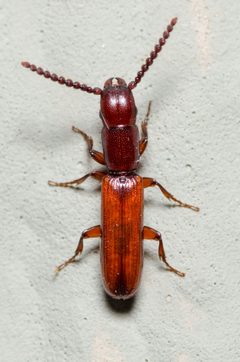
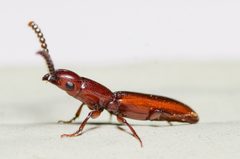
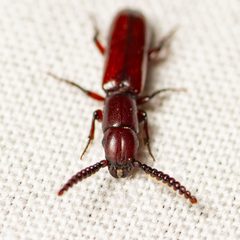
1- Taphroscelidia linearis(Round Passandrid)
Taphroscelidia is a of small beetles in the Passandridae, first described by Crotch in 1873. The genus contains approximately 13 described distributed across multiple continents. Members of this genus are classified as flat bark beetles, a group associated with woody substrates. The genus has been documented through 192 observations on iNaturalist, indicating moderate but widespread recording effort.
Pronunciation
How to pronounce Taphroscelidia: /tæf.roʊ.səˈlɪ.di.ə/
These audio files are automatically generated. While they are not always 100% accurate, they are a good starting point.
Identification
within Taphroscelidia can be distinguished by characters described in original species descriptions, including features of the pronotum, elytral , and body proportions. Taphroscelidia linearis, described by LeConte, is the only North American species in the and can be distinguished from by its geographic range. Taphroscelidia contorta and T. dentata were described by Burckhardt & Slipinski based on distinctive morphological features. Several species were originally described by Grouvelle and Reitter in the late 19th and early 20th centuries.
Images
Habitat
As members of Passandridae, in this are associated with woody , including under bark and in decaying wood. The is commonly known as flat bark beetles due to their flattened body form adapted for living in confined spaces beneath bark.
Distribution
The has a broad distribution with described from North America (T. linearis), South America (T. gounellei, T. postica), and other regions including Europe and Asia (species described by Reitter and Grouvelle). The 192 iNaturalist observations suggest presence across multiple continents, though specific range maps are not available.
Ecological Role
As flat bark beetles, members of Passandridae including Taphroscelidia are part of the saproxylic —organisms dependent on dead or dying wood. They contribute to wood decomposition processes and serve as prey for other forest-dwelling organisms.
Similar Taxa
- Other Passandridae generaFlat bark beetles in related share the flattened body form and bark-dwelling habits; specific diagnostic features for Taphroscelidia require examination of mouthpart structure and genitalia as detailed in taxonomic revisions by Burckhardt and Slipinski.
- CucujidaeAnother of flat bark beetles with similar and ; Passandridae can be distinguished by antennal structure and other internal features.
More Details
Taxonomic History
The was established by Crotch in 1873. Major revisions were conducted by Burckhardt and Slipinski, who described new and clarified relationships within the genus. The genus includes species described by several prominent coleopterists of the late 19th and early 20th centuries, including Grouvelle, Reitter, Sharp, and LeConte.
iNaturalist Documentation
The has accumulated 192 research-grade observations on iNaturalist, indicating it is encountered with some regularity by naturalists, though many observations may represent the more widespread North American T. linearis.