
Phenolia
Erichson, 1843
Species Guides
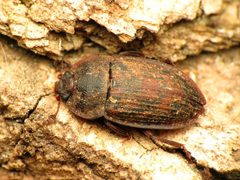
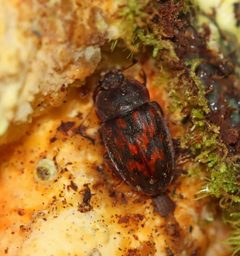
1Phenolia is a of sap-feeding beetles in the Nitidulidae, established by Erichson in 1843. The genus contains approximately nine described distributed across multiple regions. Members of this genus are associated with fermenting plant materials and sap flows. One species, Phenolia (Lasiodites) picta, has become a notable in Europe and the Middle East.
Pronunciation
How to pronounce Phenolia: /fəˈnoʊliə/
These audio files are automatically generated. While they are not always 100% accurate, they are a good starting point.
Images
Distribution
The has been recorded from multiple continents. occur in Asia (Japan, Myanmar, Iran), Europe (Greece, Spain, France, Turkey), and North America (United States, including Vermont). Individual species show varying distributions: Phenolia picta is an spreading through Europe and the Middle East.
Diet
Sap-feeding; members of this feed on plant sap and associated fermenting materials. Phenolia picta has been observed causing damage to plants.
Behavior
Larvae of Phenolia picta exhibit escape in response to substrate-borne vibrations.
Human Relevance
Phenolia picta is an with potential economic implications due to damage to plants. The species has been introduced to and established in multiple European countries and Iran.
More Details
Subgeneric classification
Some , including the well-studied P. picta, have been placed in the subgenus Lasiodites. A new subgenus has been described from Myanmar Cretaceous amber, indicating the has a fossil record extending to the Cretaceous period.
Research focus
Most biological research on this has focused on Phenolia picta, particularly regarding its spread, olfactory responses, larval , and seasonal in Japan.
Sources and further reading
- BugGuide
- Wikipedia
- GBIF taxonomy match
- iNaturalist taxon
- NCBI Taxonomy
- First record of the invasive exotic sap beetle Phenolia (Lasiodites) picta (Coleoptera: Nitidulidae) in Greece
- First record of the alien exotic sap beetle Phenolia (Lasiodites) picta (Coleoptera: Nitidulidae) in Greece
- First report of an exotic sap beetle, Phenolia (Lasiodites) picta (Macleay, 1825) (Coleoptera, Nitidulidae) from Iran with notes on its distribution range and damage on different hosts
- Seasonal Prevalence and Life History of the Sap Beetle <i>Phenolia</i>(<i>Lasiodites</i>)<i>picta</i>(Coleoptera: Nitidulidae)
- Sex Differences in the Distribution and Olfactory Response of the Sap Beetle, <i>Phenolia</i>(<i>Lasiodites</i>)<i>picta</i>(Coleoptera: Nitidulidae)
- Escape Behavior Induced by Substrate-borne Vibrations in Larvae of the Sap Beetle, <i>Phenolia</i>(<i>Lasiodites</i>)<i>picta</i>(Coleoptera: Nitidulidae). 振動が誘発するアカマダラケシキスイ(コウチュウ目:ケシキスイ科)幼虫の逃避行動
- A New Subgenus of the Genus Phenolia (Coleoptera, Nitidulidae) from Myanmar Cretaceous Amber with Taxonomic, Phylogenetic and Bionomic Notes on the 'Nitidulid' Group of Families.