
Pediacus
Shuckard, 1839
Species Guides
8- Pediacus andrewsi(Andrews' flat bark beetle)
- Pediacus depressus(flat bark beetle)
- Pediacus fuscus
- Pediacus gracilis
- Pediacus hesperoglaber
- Pediacus ommatodon
- Pediacus stephani(flat bark beetle)
- Pediacus subglaber
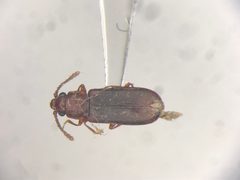
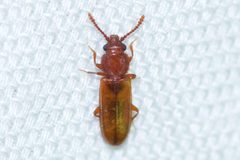
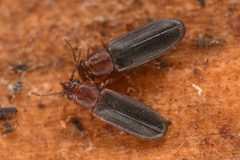
Pediacus is the largest in the Cucujidae, containing 31 recognized of flat bark beetles. are small (2.7–7.0 mm), flattened, brownish beetles with reduced or absent temples and short, distinctly clubbed . The genus is primarily Holarctic in distribution but extends to Guatemala at high elevations and to Australia. Members are saproxylic, occurring under dead bark, frequently that of conifers in North America.
Pronunciation
How to pronounce Pediacus: /ˈpɛdiˌæ.kəs/
These audio files are automatically generated. While they are not always 100% accurate, they are a good starting point.
Identification
Distinguished from other cucujid by the combination of small size, strongly flattened body, reduced or absent temples, and short, distinctly clubbed . Male genitalia are inverted with a short , a diagnostic feature for the genus.
Images
Appearance
Small, flattened beetles measuring 2.7–7.0 mm in length. Body brownish in color. with no or very small temples. short with a distinct club. Male genitalia inverted, with a short .
Habitat
Saproxylic; and larvae occur under dead bark. In North America, frequently associated with conifer bark. Found at high altitudes in southern parts of the range.
Distribution
Holarctic distribution extending south to Guatemala in the Western Hemisphere (at high altitudes) and into Australia in the Eastern Hemisphere. Records from Denmark, Norway, Sweden, and Bulgaria.
Diet
Thought to be .
Host Associations
- conifers - bark Frequently associated with conifer bark in North America
- several host tree species - bark Specific identity not provided in available sources
Behavior
have been captured with interception traps, indicating flight activity. Both adults and larvae occur under dead bark.
Ecological Role
Saproxylic ; contributes to dead wood decomposition processes in forest .
More Details
Taxonomic status
The is relatively well-known taxonomically, with most of the world fauna recently revised.
Fossil record
A single fossil , Pediacus periclitans Scudder, has been described from Eocene deposits at Florissant, Colorado, though its assignment to Pediacus has been questioned.