
Cryptophagus cellaris
(Scopoli, 1763)
cellar beetle, cellar fungus beetle
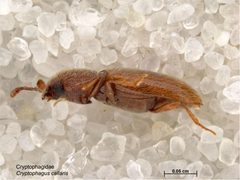
Cryptophagus cellaris is a small in the Cryptophagidae, commonly called the cellar beetle or cellar . It belongs to a group known as silken fungus beetles, which are associated with fungal growth. The has a broad distribution spanning Europe, Northern Asia (excluding China), and North America. It is one of the more frequently encountered members of its in human-associated environments.
Pronunciation
How to pronounce Cryptophagus cellaris: /ˌkrɪptoʊˈfæɡəs ˈsɛlərɪs/
These audio files are automatically generated. While they are not always 100% accurate, they are a good starting point.
Identification
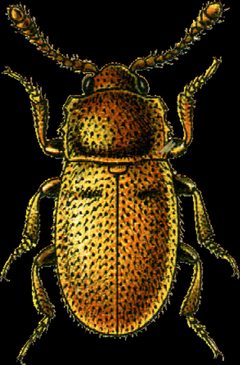
Members of Cryptophagidae are small, oval beetles, usually 1–3 mm in length, with clubbed and often pubescent (hairy) . Cryptophagus are distinguished from related by antennal structure and details of the pronotal and elytral . C. cellaris specifically may be recognized by its association with damp, fungus-rich such as cellars, though precise external diagnostic features require microscopic examination and comparison with congeneric species.
Images
Habitat
Associated with damp, dark environments where fungal growth occurs. Frequently recorded from cellars, basements, and other human structures with high humidity and mold presence. Also found in natural settings with decaying organic matter and fungal substrates.
Distribution
Europe; Northern Asia (excluding China); North America. Specific regional records include the Azores (Faial, Graciosa, Pico, São Miguel, Santa Maria).
Diet
Feeds on fungal growth, including molds and mildews. As a silken fungus beetle, it consumes , spores, and other fungal tissues.
Ecological Role
Contributes to decomposition by consuming fungal in damp, decaying environments. May help regulate mold in enclosed spaces.
Human Relevance
Frequently encountered in cellars, basements, and other damp indoor spaces where mold growth occurs. Generally considered a nuisance pest rather than a damaging , as it does not attack stored products or structural materials directly. Its presence often indicates moisture and fungal problems in buildings.
Similar Taxa
- Cryptophagus spp.Other in the share similar size, shape, and preferences; precise identification requires examination of antennal segments, pronotal shape, and elytral patterns.
- Atomaria spp.Another of Cryptophagidae with similar and appearance; distinguished by antennal club structure and body proportions.
More Details
Taxonomic history
First described by Giovanni Antonio Scopoli in 1763, making it one of the earlier described in the Cryptophagus.