
Antherophagus ochraceus
Melsheimer, 1844
silken fungus beetle
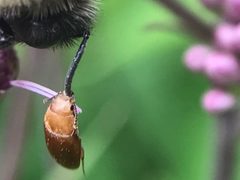
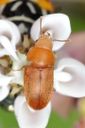
Antherophagus ochraceus is a silken fungus beetle ( Cryptophagidae) native to North America. It is one of the largest members of its family, measuring 4-5 mm as an . The exhibits a distinctive phoretic relationship with bumblebees, attaching to bees to reach their nests where larvae develop.
Pronunciation
How to pronounce Antherophagus ochraceus: /ænˌθɛrəˈfeɪɡəs oʊˈkreɪsiəs/
These audio files are automatically generated. While they are not always 100% accurate, they are a good starting point.
Identification
Distinguished from similar Antherophagus and other cryptophagid by its larger size (4-5 mm versus typically smaller), uniform yellow coloration without darker markings, golden , reduced size, and smooth curved pronotum shape.
Images
Habitat
occur on flowers in open . Larvae develop exclusively within bumblebee nests.
Distribution
North America. Documented from Canadian provinces including Alberta, British Columbia, and Manitoba.
Seasonality
active from May to September.
Diet
feed on pollen and nectar. Larvae consume organic matter within bumblebee nests including honey, , and comb debris.
Host Associations
- Bombus - and nesting site attach to legs, mouthparts, or of bumblebees to be transported to nests; larvae develop in nests
Life Cycle
are laid in bumblebee nests. Larvae develop within the nest, feeding on nest debris. and occur within the nest or after .
Behavior
engage in , clamping onto bumblebees with their and remaining attached until the returns to its nest. Adults are found on flowers where they interact with bumblebees.
Ecological Role
Commensal inhabitant of bumblebee nests; larvae contribute to decomposition of organic matter within nests.
Similar Taxa
- Other Antherophagus speciesA. ochraceus distinguished by larger size and uniform yellow coloration; typically smaller and often with darker patterning
- Other CryptophagidaeMost cryptophagids are smaller than 4 mm and lack the combination of large size, entirely yellow body, and golden
More Details
Phoresy mechanism
Attachment to bumblebees is achieved by clamping onto the 's body; beetles do not release until reaching the nest