
Murmidiidae
Jacquelin du Val, 1858
Genus Guides
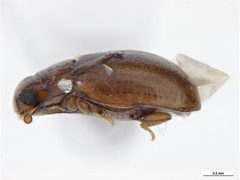
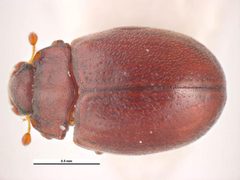
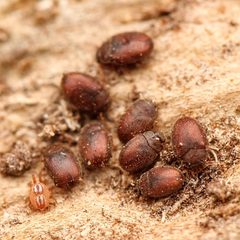
3Murmidiidae is a of small beetles in the superfamily Coccinelloidea, containing approximately 34 described across four . The family was historically classified within Cerylonidae but has been recognized as distinct based on morphological and phylogenetic evidence. Members are primarily associated with decaying wood and are considered mycophagous. The species Murmidius ovalis has been documented as a pest of stored food products.
Pronunciation
How to pronounce Murmidiidae: /mʌrˈmɪdi.aɪdiː/
These audio files are automatically generated. While they are not always 100% accurate, they are a good starting point.
Identification
Separation from the related Cerylonidae requires examination of detailed morphological characters, including differences in antennal structure and genitalia. The family is distinguished by features of the mesoventrite and metaventrite. Identification to level relies on characters of the pronotum, elytral punctation, and male genitalia. Specimens are small, generally less than 3 mm in length, with compact oval bodies.
Images
Habitat
Found primarily under the bark of recently dead trees, where they inhabit the interface between bark and wood. The microhabitat provides access to fungal growth on decaying phloem and cambium tissues.
Distribution
Worldwide distribution with documented presence across multiple continents. Murmidius ovalis has a distribution associated with human commerce.
Diet
Thought to be mycophagous, feeding on fungal and spores present in decaying wood. The diet of Murmidius ovalis in stored food environments has been observed to include various mold fungi.
Ecological Role
Decomposers in forest , contributing to the breakdown of dead wood through their association with fungal . Murmidius ovalis acts as a secondary pest in stored food systems, where its presence indicates fungal rather than direct commodity damage.
Human Relevance
Murmidius ovalis is noted as a pest of stored food, though its economic impact is minor compared to primary stored product pests. Its presence in food storage facilities indicates pre-existing fungal . The has no other documented significance to agriculture, forestry, or human health.
Similar Taxa
- CerylonidaeHistorically included within Cerylonidae; separation requires examination of thoracic characters and antennal club structure
- BothrideridaeSimilar small size and association with dead wood; distinguished by different antennal and lack of mycophagous adaptations
- PassandridaeOverlapping preferences under bark; Passandridae are primarily predatory on wood-boring beetles rather than mycophagous
More Details
Taxonomic history
The was established by Jacquelin du Val in 1858 but was long treated as a or synonym of Cerylonidae. Molecular and morphological studies in the early 21st century supported its elevation to family rank within Coccinelloidea.
Genera
The contains four : Botrodus (4 ), Murmidius (approximately 20 species), Mychocerinus (approximately 9 species), and Murmidiella (1 species, described 2022).