
Cortinicara
Johnson, 1975
Species Guides
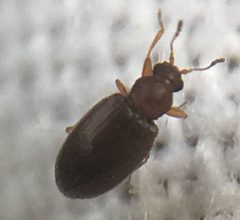
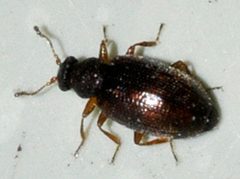
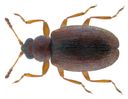
1- Cortinicara gibbosa(minute brown scavenger beetle)
Cortinicara is a of minute brown scavenger beetles in the Latridiidae, established by Johnson in 1975. The genus contains approximately 15 described distributed across multiple continents, including species originally described from Afghanistan, Bhutan, China, New Zealand, and North America. Species in this genus are small, cryptic beetles associated with moist, decaying organic matter.
Pronunciation
How to pronounce Cortinicara: //kɔːrˈtɪnɪˌkɑːrə//
These audio files are automatically generated. While they are not always 100% accurate, they are a good starting point.
Identification
Members of Cortinicara are distinguished from other Latridiidae by subtle morphological features of the pronotum and , including specific patterns of punctation and setation. The genus name references a cortina-like (web-like) structure, though specific diagnostic characters require examination of microscopic features. Accurate identification to level typically requires reference to original descriptions and comparison with .
Images
Distribution
Recorded from Denmark, Norway, Sweden, the United States (including Vermont), and described from Afghanistan, Bhutan, China (Fujian), New Zealand, and the Philippines (Luzon).
Similar Taxa
- LatridiusAnother in Latridiidae; Cortinicara may be distinguished by specific pronotal and elytral sculpturing patterns, though microscopic examination is required for reliable separation.
- DienerellaClosely related in the same ; differences in antennal club structure and body proportions are used to separate these .
More Details
Taxonomic history
The was established by C. Johnson in 1975, with Cortinicara meridiana Johnson, 1975 as the type . Several species were subsequently transferred from other genera or newly described by Johnson in 1977, 1989, and 1990, and by Rücker in 1984.
Species diversity
The includes with type localities spanning temperate and subtropical regions: C. gibbosa (Europe), C. hirtalis and C. vagepunctata (New Zealand), C. andersoni (Australia), C. afghana and C. bhutanica (Central/South Asia), C. fukiensis (China), C. luzonica (Philippines), and C. blatchleyi (North America).