
Psyllobora parvinotata
Casey, 1899
Small-spotted Fairy Lady Beetle, small-spotted psyllobora
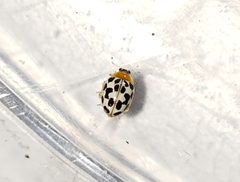
Psyllobora parvinotata is a minute lady beetle in the tribe Psylloborini, distinguished by its reduced spot pattern compared to . measure 2.75–3.40 mm and exhibit pale, often faint markings on the . The occurs in the southeastern United States, with records from Florida to Louisiana. It belongs to a whose members are specialized feeders on powdery mildews and other plant-pathogenic fungi.
Pronunciation
How to pronounce Psyllobora parvinotata: //ˌsɪl.oʊˈbɔːr.ə ˌpɑːr.viː.noʊˈtæ.tə//
These audio files are automatically generated. While they are not always 100% accurate, they are a good starting point.
Identification
Distinguished from the similar Psyllobora vigintimaculata by its smaller size, paler and less distinct elytral spots, and pronotum that typically lacks dark spots or bears only pale ones. The spot pattern is consistently reduced compared to with more conspicuous markings. Examination of the pronotum and spot intensity is usually sufficient for separation from the commoner 20-spotted lady beetle.
Images
Appearance
are small, oval, and convex, measuring 2.75–3.40 mm in length. The ground color is pale, with elytral spots that are distinctly paler and less contrasting than those of related . The pronotum typically lacks spots entirely or bears only pale, inconspicuous spots. The overall color pattern is subdued compared to the boldly marked Psyllobora vigintimaculata.
Distribution
Southeastern United States; recorded from Florida to Louisiana. The range appears restricted to the Gulf Coastal Plain and adjacent regions.
Diet
As a member of Psyllobora, likely feeds on powdery mildews (Erysiphales) and other fungal plant , though specific feeding records for this are not documented.
Ecological Role
Probable mycophagous or of plant-pathogenic fungi, potentially contributing to natural suppression of powdery mildew on vegetation.
Similar Taxa
- Psyllobora vigintimaculataLarger size (typically), more numerous and darker contrasting spots on , pronotum usually with distinct dark spots; P. parvinotata has paler, reduced spotting and often pronotum
More Details
Taxonomic note
Described by Casey in 1899; the specific epithet parvinotata ('small-spotted') directly references the reduced spot pattern that distinguishes this .
Collection records
Documented from blacklight trapping in autumn, suggesting activity or at least positive .