
Naemia
Mulsant, 1850
Species Guides
1- Naemia seriata(Seaside Lady Beetle)
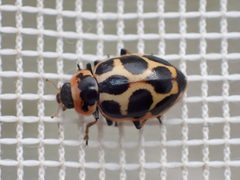
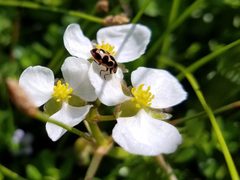
Naemia is a of lady beetles in the Coccinellidae, established by Mulsant in 1850. The genus is , containing only the Naemia seriata, commonly known as the seaside lady beetle. This coastal is native to North America and is distinguished by its elongately oval body and distinctive spot patterns on the and pronotum.

Pronunciation
How to pronounce Naemia: /neɪˈmiːə/
These audio files are automatically generated. While they are not always 100% accurate, they are a good starting point.
Identification
Members of this can be distinguished from similar coccinellids by their elongately oval body shape and the characteristic merging of the pair of spots on the . The pronotum typically bears one large central black spot, occasionally split into two. The genus is further distinguished from the superficially similar Coleomegilla maculata by its strictly coastal distribution and merged elytral and pronotal markings, whereas C. maculata has distinctly separate markings and occurs in a wide range of terrestrial .
Images
Habitat
Strictly coastal; found in beach, salt marsh, and bay island environments along ocean shores.
Distribution
North America; Atlantic and Pacific coasts. The sole N. seriata has two with non-overlapping ranges: N. seriata seriata occurs from Rhode Island to southern Texas including Bermuda, while N. seriata litigiosa is restricted to the American Southwest.
Human Relevance
May be confused with the common spotted pink ladybeetle (Coleomegilla maculata) by observers, but has no documented direct economic or agricultural significance.
Similar Taxa
- Coleomegilla maculataSimilar coloration and spot patterns, but distinguished by separate (not merged) elytral and pronotal markings, more common occurrence, and non-restricted terrestrial distribution.
More Details
Taxonomic status
The Naemia is currently considered , with Naemia seriata as the sole described . Two are recognized: N. seriata seriata and N. seriata litigiosa, distinguished by coloration.
Etymological note
The name Naemia has been confused with the medical suffix '-naemia' (blood condition) in unrelated clinical literature, but is properly a coccinellid genus established in 1850.
Sources and further reading
- BugGuide
- Wikipedia
- GBIF taxonomy match
- iNaturalist taxon
- NCBI Taxonomy
- Catalogue of Life
- Molecular mechanisms of pathology and treatment in Diamond Blackfan Anaemia
- Iron supplementation in children to prevent deficiency and anaemia: A qualitative synthesis.
- Effective management of pediatric septic shock: a case study utilizing continuous renal replacement therapy with cytosorb and citrate in a leukemic patient with hyper-interleukin (IL)-6-naemia and severe thrombocytopenia.
- Modelling the interrelationships between potential risk factors and childhood Co-morbidity of Malaria, Anaemia, and stunting in children less than five years in Burundi.
- Severe Hypertriglyceridaemia and Chylomicronaemia Syndrome-Causes, Clinical Presentation, and Therapeutic Options.