
Philothermus glabriculus
LeConte, 1863
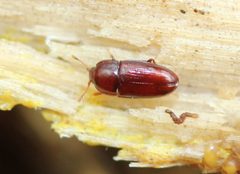
Philothermus glabriculus is a minute bark beetle in the Cerylonidae, first described by LeConte in 1863. The occurs in North America, with records from Canada (New Brunswick, Nova Scotia, Ontario) and the broader continent. It belongs to a of small beetles associated with decaying wood and fungal . As with other Cerylonidae, it is likely associated with subcortical environments, though specific ecological details remain limited.
Pronunciation
How to pronounce Philothermus glabriculus: /ˌfɪloʊˈθɜrməs ɡləˈbrɪkjʊləs/
These audio files are automatically generated. While they are not always 100% accurate, they are a good starting point.
Identification
Identification to requires examination of subtle morphological characters such as antennal club structure, pronotal shape, and elytral punctation patterns. Distinguished from other Philothermus species by specific combinations of these features described in LeConte's original . Separation from other Cerylonidae relies on body shape and antennal .
Images
Habitat
Associated with bark and subcortical of trees; specific associations are not documented. Occurs in forested environments where decaying wood and fungal growth provide suitable microhabitats.
Distribution
North America, with confirmed records from New Brunswick, Nova Scotia, and Ontario in Canada. Distribution likely extends throughout eastern North America based on collection patterns, though precise range boundaries are not established.
Human Relevance
No documented economic or medical significance. Too small to be a timber pest; likely overlooked due to minute size and cryptic habits.
Similar Taxa
- Other Philothermus species share minute size, rounded body form, and bark beetle habits; require detailed examination of antennal and pronotal characters for separation.
- Cerylonidae (family members)-level characters of compact body, clubbed , and small size overlap; -level identification requires knowledge.
More Details
Taxonomic note
The Philothermus has undergone taxonomic revision; some historical literature may use outdated combinations or synonymies. Current placement in Cerylonidae follows modern phylogenetic treatments of the superfamily Cucujoidea.