
Axinotarsus pulicarius
(Fabricius, 1777)
soft-winged flower beetle
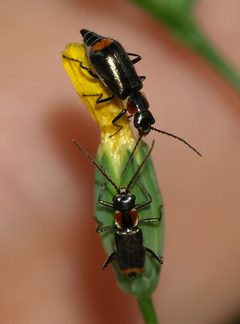
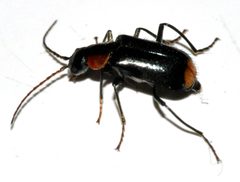
A small soft-winged flower beetle (Melyridae) measuring 2.75–3.75 mm, distinguished by a reddish-yellow pronotum with a broad black band contrasting with dark grey to nearly black and . Native to Europe with broad distribution excluding northern latitudes and southern Mediterranean regions; introduced to North America where established in the Pacific Northwest and Great Lakes region. Known for elaborate courtship involving excitatory gland displays and mutual frontal tapping between sexes.

Pronunciation
How to pronounce Axinotarsus pulicarius: /ˌæksɪnoʊˈtɑrsəs ˌpjʊlɪˈkɛəriəs/
These audio files are automatically generated. While they are not always 100% accurate, they are a good starting point.
Identification
Distinguished from other Axinotarsus and small Melyridae by the combination of: small size (under 4 mm); reddish-yellow pronotum with a broad, well-defined black longitudinal band; and contrasting dark grey to black and . The pronotal color pattern is the primary diagnostic feature separating this from .
Images
Distribution
Native to Europe with broad distribution across the continent, absent from northern latitudes and southern Mediterranean regions. Introduced to North America: established in Pacific Northwest (notably Greater Vancouver, British Columbia) and Great Lakes region (notably Greater Toronto area, Ontario).
Diet
Pollen of grasses in native European range.
Behavior
Courtship involves complex ritualized interactions: males display excitatory glands to females; females taste glandular secretions, which reduces mating inhibition. Both sexes engage in frontal tapping. Male turns back to female, who bites the gland; female then turns back to male, who places mouthparts on tip of her . Copulation may follow immediately or pair may return to frontal tapping.
Similar Taxa
- Other Axinotarsus speciesDistinguished by the unique pronotal color pattern of reddish-yellow with broad black band; lack this specific contrasting pattern.
- Other small MelyridaeSize and distinctive pronotal banding pattern separate this from other small soft-winged flower beetles in the same region.
More Details
Nomenclatural history
Originally described as Malachius pulicarius by Fabricius in 1777; later transferred to Axinotarsus.
Courtship gland chemistry
Male excitatory glands produce secretions that females taste; this chemical signaling plays a critical role in reducing female mating inhibition, representing a documented case of chemical communication in courtship.