
Systena frontalis
(Fabricius, 1801)
red-headed flea beetle, Red-headed Systena
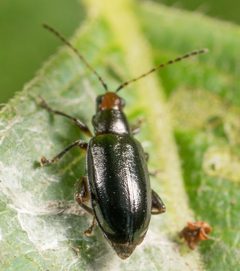
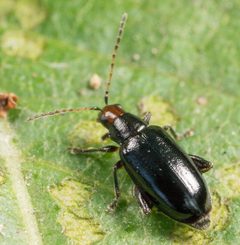
Systena frontalis, commonly known as the red-headed flea beetle, is a flea beetle in the Chrysomelidae native to North America. It has become a significant economic pest of ornamental plant nurseries across the central and eastern United States, particularly affecting container-grown plants. feed on foliage, creating shotholes and skeletonization that reduce plant salability. The species has expanded its pest status to cranberry production systems and shows a broad range encompassing numerous woody ornamental species. Its includes holometabolous development with four larval instars, and it overwinters as in growing medium or soil.
Pronunciation
How to pronounce Systena frontalis: /sɪsˈtiː.nə frɔnˈtæ.lɪs/
These audio files are automatically generated. While they are not always 100% accurate, they are a good starting point.
Identification
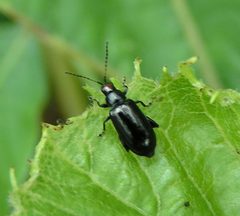
The red-headed flea beetle is distinguished from other Systena and flea beetles by the combination of its red and black body. In Virginia nurseries, it can be confused with other small leaf-feeding beetles, but the distinctive color pattern separates it. Larvae are difficult to identify to species without rearing, but their presence in container growing media of ornamental plants, combined with characteristic damage patterns, aids . Adult size differences between sexes (females notably larger) may assist in field identification.
Images
Habitat
Primarily associated with container ornamental plant nurseries in the central and eastern United States. Also found in agricultural crop systems including cranberries. are active in open, sunny conditions within nursery settings. Larvae develop in growing medium of containerized plants or in soil, with and larvae found relatively deep (>30 cm) in soil profiles.
Distribution
Native to North America. Documented from Manitoba, New Brunswick, and Nova Scotia in Canada, and widespread across the central and eastern United States including the Midwest, Northeast, and Southeast regions. GBIF records confirm presence across North America.
Seasonality
In eastern Virginia, exhibit three with abundance peaks in June, late July, and late August to early September. Adults are most active diurnally from 1100 to 1500 hours. In cranberry systems, adults emerge sporadically over summer. Under natural conditions, one generation per year occurs, but up to four generations per year are possible in container production environments.
Diet
feed on leaves of numerous plant , creating shotholes and skeletonization. Documented include Hydrangea paniculata, Itea virginica, Weigela florida, Cornus sericea, Vaccinium macrocarpon (cranberry), and many other woody ornamentals including Rosa, Rhododendron, Osmanthus fragrans, Salvia, Sedum, Viburnum, Loropetalum chinense, Forsythia, Lagerstroemia, Buddleja, Abelia, Gardenia, Guara, Illicium, Pyracantha, and Myrica cerifera. Feeding preference studies show adults prefer mature leaves over young leaves in choice assays, though damage rates are higher on young leaves when no choice is available. Larval diet in containers is presumed to include roots and organic matter in growing media.
Host Associations
- Hydrangea paniculata - primary Major ornamental in nurseries
- Vaccinium macrocarpon - Emerging pest in cranberry production
- Itea virginica - Used in preference studies
- Weigela florida - No feeding preference detected among cultivars
- Cornus sericea - Used in preference studies
- Rosa - Nursery
- Rhododendron - Nursery
- Osmanthus fragrans - Nursery
- Salvia - Nursery
- Sedum - Nursery
- Viburnum - Nursery
- Loropetalum chinense - Nursery
- Forsythia - Nursery
- Lagerstroemia - Nursery
- Buddleja - Nursery
- Abelia - Nursery
- Gardenia - Nursery
- Guara - Nursery
- Illicium - Nursery
- Pyracantha - Nursery
- Myrica cerifera - Nursery
- Vernonia fasciculata - Common ironweed, documented feeding damage
- Zea mays - Corn, historical association
Life Cycle
Holometabolous development with , four larval instars, pupa, and stages. Eggs are deposited in growing medium or soil. Larvae develop through four instars with predictable increases in capsule width consistent with . occurs in growing medium or soil. Overwinters as eggs in growing medium or soil; cold treatment between 0 and 5°C for 15 weeks significantly increases egg hatch compared to warmer temperatures or shorter/longer cold periods. Under natural conditions, one per year; up to four generations possible in container production environments. In eastern Virginia, three generations occur with adult peaks in June, late July, and late August to early September.
Behavior
are with peak activity from 1100 to 1500 hours. They are capable of jumping using saltatorial hind legs. Adults feed on foliage during the day, producing characteristic shothole damage. In choice assays, adults preferentially feed on mature leaves over young leaves. Adults are patchily distributed in fields. Phenylethyl alcohol was tested as an attractant but found ineffective under nursery conditions. Adults emerge from sites in growing medium and move to new plant growth.
Ecological Role
Herbivore in native , but primarily known as an economic pest in anthropogenic environments. No documented ecological role in natural is described in available literature. The appears to have expanded from native plants into ornamental nursery systems over the past two decades.
Human Relevance
Major economic pest of container ornamental plant nurseries in the central and eastern United States, causing significant losses through reduced plant salability due to foliar damage. Emerging pest in cranberry production systems. Management relies on applications, with research ongoing to optimize timing and reduce use. insecticides (thiamethoxam, dinotefuran, cyantraniliprole, acephate, imidacloprid) and foliar applications (acetamiprid, pyrethrins, tetraniliprole, cyclaniliprole) have demonstrated efficacy. Residual activity varies, with tetraniliprole providing longer-term protection. Sustainable management practices are being researched to reduce reliance on frequent pesticide applications.
Similar Taxa
- Systena blandaPale-striped flea beetle, also a Chrysomelidae pest of sunflowers and crops; distinguished by pale stripes and different coloration
- Other flea beetles (Alticini)Share jumping hind legs and small size, but S. frontalis distinguished by red and black body coloration
More Details
Pest Management Research
Multiple recent studies have focused on optimizing applications for S. frontalis management. insecticides applied to growing medium show promise for reducing labor costs associated with foliar sprays. Research priorities identified by stakeholders include improving phenological models, refining scouting protocols, and understanding larval in growing media.
Female Reproductive Development
Ovarian development has been categorized into three stages: pre-vitellogenic, vitellogenic, and post-vitellogenic, based on ovarian and development. This characterization supports improved timing of management interventions.
Sources and further reading
- BugGuide
- Wikipedia
- GBIF taxonomy match
- iNaturalist taxon
- NCBI Taxonomy
- Encyrtid Holdings | Entomology Research Museum
- Meloidae Holdings | Entomology Research Museum
- Southern Pine Beetle: How a Fellow Species May Help in Host Location
- Managing Southern Pine Beetle Infestations in a Changing Forest Environment
- Communication is Power: Here's How Entomologists Can Use It
- Bug Eric: More Insects From Sunflowers
- Biology of Systena frontalis with Special Reference to Corn12
- Biometrics of Systena frontalis (Coleoptera: Chrysomelidae) on Hydrangea paniculata Siebold
- Biology and management of Systena frontalis (Coleoptera: Chrysomelidae) in ornamental plant nurseries
- Temporal and spatial factors influencing Systena frontalis (Coleoptera: Chrysomelidae) behavior in Virginia nurseries
- Correction to: Biology and management of Systena frontalis (Coleoptera: Chrysomelidae) in ornamental plant nurseries
- Correction to: Biology and management of Systena frontalis (Coleoptera: Chrysomelidae) in ornamental plant nurseries
- Life History and Damage by Systena frontalis F. (Coleoptera: Chrysomelidae) on Vaccinium macrocarpon Ait.
- Feeding potential of adult Systena frontalis (Coleoptera: Chrysomelidae) on leaves of Hydrangea paniculata (Cornales: Hydrangeaceae)
- Review and Current Status of Systena frontalis (Coleoptera: Chrysomelidae): An Insect Pest Associated with Nursery Production Systems
- Residual activity of insecticides against adult Systena frontalis (Coleoptera: Chrysomelidae) under semi-field conditions
- Overwintering, Host-Plant Selection, and Insecticide Susceptibility of Systena frontalis (Coleoptera: Chrysomelidae): A Major Insect Pest of Nursery Production Systems
- Evaluation of Systemic Insecticides in Protecting Container-Grown Nursery Plants from Damage Caused by Field-Collected Populations of Redheaded Flea Beetle, Systena frontalis (Coleoptera: Chrysomelidae), Adults
- Optimizing Foliar Spray Intervals and Rates of Isocycloseram and Cyantraniliprole Plus Thiamethoxam Application on Hydrangea paniculata to Combat Adult Systena frontalis (F) (Coleoptera: Chrysomelidae).