
Systena bitaeniata
(LeConte, 1859)
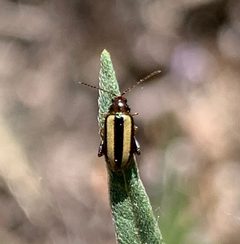
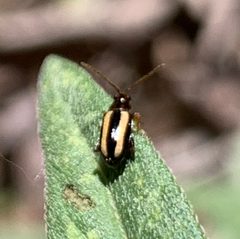
Systena bitaeniata is a of flea beetle in the Chrysomelidae, native to North America. The Systena includes small leaf beetles commonly associated with various plants. This species is part of a diverse group of chrysomelid beetles that feed on plant foliage.
Pronunciation
How to pronounce Systena bitaeniata: /sɪsˈtiːnə ˌbaɪtiːniˈɑːtə/
These audio files are automatically generated. While they are not always 100% accurate, they are a good starting point.
Identification
Members of the Systena are small leaf beetles, typically 3–5 mm in length, with enlarged hind adapted for jumping—a characteristic trait of flea beetles (tribe Alticini). Systena bitaeniata can be distinguished from by the presence of two pale longitudinal stripes on the dark , as indicated by the epithet "bitaeniata" (meaning "two-banded"). Specific diagnostic features separating this species from other Systena species require examination of genitalia or other subtle morphological characters.
Images
Habitat
Associated with herbaceous vegetation in open . The Systena is broadly distributed across North American plant , with typically found on forbs and shrubs.
Distribution
Recorded from North America, with specific distribution records from Alberta, Canada. The Systena occurs widely across North America.
Behavior
As a flea beetle, possesses the jumping ability characteristic of the tribe Alticini, using enlarged hind legs to escape disturbance.
Ecological Role
Herbivorous member of leaf beetle , contributing to plant-insect dynamics as a foliage feeder.
Similar Taxa
- Systena blandaAnother small North American flea beetle in the same , similarly associated with sunflowers and other Asteraceae; distinguished by pattern and preferences
- Other Alticini genera (e.g., Altica, Disonycha)Similar body plan with enlarged hind and jumping ; distinguished by -level characters including antennal structure and tarsal formula
More Details
Taxonomic Note
The specific epithet "bitaeniata" refers to the two pale longitudinal stripes on the . The Systena was established by H. Clark in 1860 and includes numerous North American , many of which are poorly documented in terms of and associations.
Data Limitations
Detailed biological information for S. bitaeniata specifically is sparse in the accessible literature. Most ecological and behavioral knowledge of the derives from studies of economically significant such as S. blanda, and direct transfer of these traits to S. bitaeniata is not warranted without confirmation.