
Lysathia
J. Bechyné, 1957
Species Guides
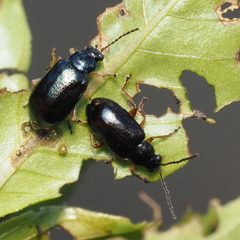
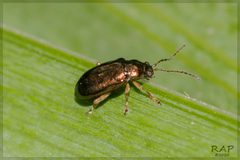
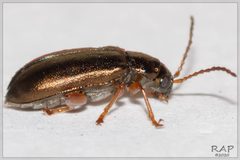
1- Lysathia ludoviciana(water-primrose flea beetle)
Lysathia is a of flea beetles (Chrysomelidae: Alticini) containing approximately 10 described distributed in North America and the Neotropics. Several species have been investigated or deployed as agents for aquatic plants, including Ludwigia grandiflora subsp. hexapetala and Myriophyllum aquaticum. The genus exhibits morphological variation that has complicated taxonomic resolution, with integrative approaches combining genetics and used to clarify species boundaries.
Pronunciation
How to pronounce Lysathia: /lɪˈsæθiə/
These audio files are automatically generated. While they are not always 100% accurate, they are a good starting point.
Identification
Members of Lysathia are flea beetles in the tribe Alticini, characterized by enlarged hind adapted for jumping. differentiation within the relies on body size, coloration, and genital structure . Lysathia flavipes exhibits significant intraspecific morphological variation that has historically complicated identification. Lysathia cilliersae is distinguished from L. flavipes and L. ludoviciana by genetic sequences, body size, coloration, and genital structures.
Images
Habitat
Aquatic and semi-aquatic environments associated with emergent or floating aquatic vegetation. are found in water bodies and river systems where their plants occur.
Distribution
Native to North America and the Neotropics, with documented occurrences in Argentina, Brazil, Uruguay, and the United States. Lysathia cilliersae has been introduced to South Africa for purposes.
Diet
Herbivorous, feeding on aquatic plants. Documented include Ludwigia grandiflora subsp. hexapetala (Onagraceae) and Myriophyllum aquaticum (Haloragaceae).
Host Associations
- Ludwigia grandiflora subsp. hexapetala (Onagraceae) - planttarget of by L. flavipes
- Myriophyllum aquaticum (Haloragaceae) - planttarget of by L. cilliersae and L. flavipes
Life Cycle
Lysathia flavipes matures from to in approximately 20 days at 25°C. Females live approximately 86 days and produce over 1,500 eggs on average.
Behavior
and larvae feed on plant foliage. Lysathia flavipes larvae feed aggressively and complete development on multiple plant regardless of origin when presented in no-choice conditions. Lysathia cilliersae exhibits strong preference for Myriophyllum aquaticum in choice tests, with preference becoming more pronounced as experimental complexity increases.
Ecological Role
Herbivore and potential agent for aquatic plants. of aquatic vegetation in native and introduced ranges.
Human Relevance
Several have been evaluated or deployed as agents for aquatic weeds. Lysathia cilliersae was released in South Africa in 1995 for control of Myriophyllum aquaticum. Lysathia flavipes was rejected as a biocontrol candidate in the USA due to insufficient specificity.
Similar Taxa
- Other Alticini generaShared enlarged hind for jumping; distinguished by genital and associations
- GraptoderaHistorical taxonomic confusion; Lysathia flavipes was originally described as Graptodera flavipes
More Details
Taxonomic history
Lysathia flavipes was originally described as Graptodera flavipes Boheman, 1859. A lectotype and paralectotypes were designated in 2024 to stabilize . Lysathia cilliersae was described as new in 2024, clarifying identity of specimens used in South African biocontrol since 1994.
Biocontrol evaluation outcomes
Lysathia flavipes was rejected for biocontrol use in the USA due to broad physiological range demonstrated in no-choice tests. In contrast, Lysathia cilliersae was confirmed as host-specific to Myriophyllum aquaticum under conditions and successfully established in South Africa.
Sources and further reading
- BugGuide
- Wikipedia
- GBIF taxonomy match
- iNaturalist taxon
- NCBI Taxonomy
- Lysathia flavipes and Lysathia cilliersae Cabrera sp. nov. (Coleoptera, Chrysomelidae): genetic and morphological unravelling of biocontrol agents for two invasive aquatic plants
- Host selection of Lysathia cilliersae across increasing experimental complexity and ecological realism
- Lysathia n.sp. (Coleoptera: Chrysomelidae), a host-specific beetle for the control of the aquatic weed Myriophyllum aquaticum (Haloragaceae) in South Africa
- Lysathia n.sp. (Coleoptera: Chrysomelidae), a host-specific beetle for the control of the aquatic weed Myriophyllum aquaticum (Haloragaceae) in South Africa
- Biological and Host Range Characteristics of Lysathia flavipes (Coleoptera: Chrysomelidae), a Candidate Biological Control Agent of Invasive Ludwigia spp. (Onagraceae) in the USA