
Disonycha triangularis
(Say, 1824)
Three-spotted Flea Beetle
Disonycha triangularis, commonly known as the three-spotted flea beetle, is a flea beetle in the Chrysomelidae. It is recognized by its distinctive triangular markings and jumping ability characteristic of flea beetles. The species is native to North America and has been documented across a broad geographic range including Canada and the United States.
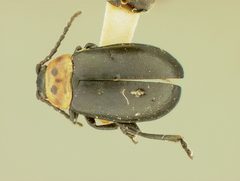
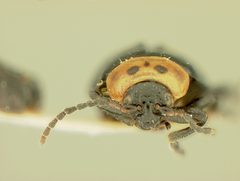
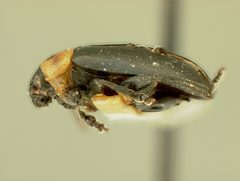
Pronunciation
How to pronounce Disonycha triangularis: //dɪˈsɒnɪkə traɪˌæŋɡjʊˈlærɪs//
These audio files are automatically generated. While they are not always 100% accurate, they are a good starting point.
Identification
The three-spotted pattern on the distinguishes this from other Disonycha species. The triangular arrangement of spots, combined with the jumping hind legs characteristic of Alticinae, separates it from non-flea beetle Chrysomelidae. Similar Disonycha species may lack the distinct three-spot pattern or show different spot arrangements.
Images
Appearance
have a compact, somewhat oval body typical of flea beetles. The bear three distinct dark spots or markings that give the its . The body is relatively small, with enlarged hind adapted for jumping. Coloration is generally dark with contrasting pale or yellowish markings.
Distribution
North America; documented from Canada (Alberta, British Columbia, Manitoba) and throughout the United States. The has a transcontinental distribution across temperate North America.
Behavior
Possesses the jumping ability characteristic of flea beetles ( Alticinae), using enlarged hind to escape . This saltatorial locomotion is a defensive .
Similar Taxa
- Other Disonycha speciesSimilar body form and size, but distinguished by the specific three-spot elytral pattern of D. triangularis
- Non-flea beetle ChrysomelidaeLack the enlarged hind and jumping ability that characterize Alticinae including Disonycha
More Details
Subspecies
Two are recognized: Disonycha triangularis montanensis Blake and Disonycha triangularis triangularis. The nominate subspecies has broader distribution, while D. t. montanensis appears restricted to montane regions.