
Disonycha leptolineata
Blatchley, 1917
Species Guides
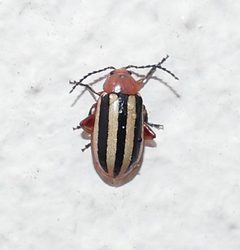
2Disonycha leptolineata is a of flea beetle in the Chrysomelidae, first described by Blatchley in 1917. Like other members of the Disonycha, it is characterized by enlarged hind adapted for jumping. The species has been documented across a broad geographic range spanning the Caribbean, Central America, and North America. It belongs to the tribe Alticini, the largest tribe within the leaf beetle family.


Pronunciation
How to pronounce Disonycha leptolineata: /dɪˈsoʊnɪkə ˌlɛptoʊˌlɪniˈeɪtə/
These audio files are automatically generated. While they are not always 100% accurate, they are a good starting point.
Identification
Members of Disonycha can be distinguished from other flea beetle by their distinctive pronotal and elytral punctation patterns. Disonycha leptolineata specifically can be separated from by its narrow, elongate elytral markings (reflected in the epithet "leptolineata," meaning "slender-lined"). The species exhibits the enlarged hind characteristic of Alticini, with hind legs modified for saltatorial locomotion. Detailed external distinguishing it from similar species such as Disonycha xanthomelas or Disonycha glabrata requires examination of genitalic structures and precise elytral pattern configuration.
Images
Distribution
Documented from the Caribbean Sea region, Central America, and North America. GBIF records confirm presence in the Caribbean, Middle America, and North America. The broad distribution suggests to varied environmental conditions across tropical and temperate zones.
Similar Taxa
- Disonycha xanthomelasSimilar size and general body form; distinguished by elytral pattern and coloration details
- Disonycha glabrataOverlapping distribution in North America; requires examination of punctation and elytral line width for separation
- Other Alticini genera (e.g., Altica, Systena)Similar jumping hind legs and general flea beetle ; Disonycha separated by distinctive body shape and pronotal structure
More Details
Etymology
The specific epithet "leptolineata" derives from Greek "leptos" (slender, thin) and Latin "lineatus" (lined, marked with lines), referring to the narrow longitudinal markings on the .