
Crepidodera violacea
Melsheimer, 1847
Violet Flea Beetle
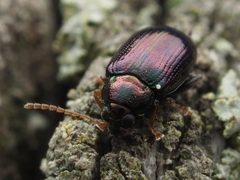
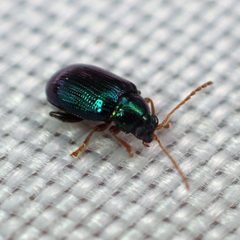
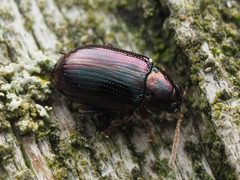
Crepidodera violacea is a of flea beetle in the Chrysomelidae. It is native to North America and belongs to the Alticinae, characterized by enlarged hind adapted for jumping. The species was described by Melsheimer in 1847. Like other flea beetles, it is likely associated with herbaceous vegetation, though specific plants are not well documented in available sources.
Pronunciation
How to pronounce Crepidodera violacea: //kɹɛpɪˈdoʊdərə ˌvaɪəˈleɪʃə//
These audio files are automatically generated. While they are not always 100% accurate, they are a good starting point.
Identification
Members of the Crepidodera are small flea beetles, typically measuring 2–4 mm in length. They can be distinguished from similar genera such as Chaetocnema by subtle morphological features of the , pronotum, and elytral . Crepidodera generally have more rounded pronotal sides and less deeply punctured compared to Chaetocnema. Specific diagnostic features for C. violacea require examination of genitalic structures or detailed comparison with .
Images
Distribution
North America. Documented from Canada (New Brunswick, Ontario, Québec) and the United States.
Behavior
As a member of the flea beetle Alticinae, possess enlarged hind with extensor tendons that enable characteristic jumping escape responses when disturbed.
Similar Taxa
- Chaetocnema spp.Similar small size, jumping ability, and general body form. Distinguished by more deeply punctured and different pronotal shape.
- Other Crepidodera speciesCongeneric require detailed examination of male genitalia or subtle external morphological differences for reliable identification.
More Details
Taxonomic note
The Crepidodera is part of the diverse flea beetle fauna of North America. -level identification in this genus often requires examination due to subtle morphological variation.