
Blepharida rhois
(Forster, 1771)
Sumac Flea Beetle
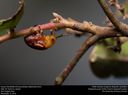
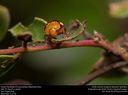
Blepharida rhois, the sumac flea beetle, is a North American flea beetle notable for its specialized diet on Rhus (sumac) plants and distinctive larval defense mechanism. possess enlarged metafemora enabling catapult jumps to escape . Larvae construct fecal shields containing plant-derived defensive compounds. This represents an outlying distribution within its , which is otherwise tropical.
Pronunciation
How to pronounce Blepharida rhois: /ˈblɛfəˌraɪdə ˈroʊɪs/
These audio files are automatically generated. While they are not always 100% accurate, they are a good starting point.
Identification
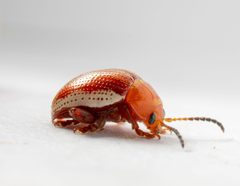
recognized by combination of: cream ground color with irregular red-brown elytral markings; orange pronotum and ; enlarged hind with visible meta femoral spring mechanism; traverse setiferous punctures on (diagnostic for within New World Blepharida). Larvae identified by gray-yellow coloration with pale stripes, black head, and presence of fecal shield. Distinguished from other flea beetles by exclusive association with Rhus plants and specific geographic range.
Images
Habitat
Associated with Rhus (sumac) plants in open, sunny environments; found in fields, ditches, and along edges where sumac grows; seek sheltered microhabitats under leaves, soil, or debris near feeding sites
Distribution
North America; eastern distribution from Virginia west to Alberta and Montana; most common in northern regions; atypical outlier within Blepharida , which is otherwise restricted to tropical Africa and New World tropics
Seasonality
active from early spring through September with peak larval feeding late May to early June; adults aestivate during July heat, re-emerging late summer; as adults in protected locations; two per summer maximum
Diet
Obligate on Rhus (sumac); and larvae feed externally on leaf surfaces; larvae prefer youngest leaf tissue and flower buds; specifically associated with smooth sumac (Rhus glabra)
Host Associations
- Rhus glabra - primary smooth sumac
Life Cycle
laid in clusters on branches and leaves, covered with fecal material; elliptical, 0.4 mm, white to yellowish-gray; hatch after approximately 10-14 days; four larval instars; first instars appear in early spring coinciding with leaf expansion; larvae feed 2-3 weeks before descending to soil to pupate; pupal stage approximately two weeks; emerge, feed through summer, overwinter; females oviposit over several weeks, laying several hundred eggs; maximum two per summer
Behavior
perform catapult jumps using meta femoral spring mechanism to escape ; jumping involves four-phase physiological process with acceleration reaching maximum speed in under 1 ms; adults sedentary when food abundant, fly longer distances when resources scarce; larvae solitary on young leaflets, may line up in groups on older leaves; larvae construct and maintain fecal shields throughout feeding period using neuromuscular propulsion to transport from anal opening to back
Ecological Role
Herbivore and folivore on Rhus; larval feeding can cause localized defoliation; patchy herbivory pattern influenced by plant secondary chemistry; fecal shields provide chemical defense derived from hydrolyzed plant tannins; contributes to nutrient cycling through larval-pupal transition in soil
Human Relevance
Considered minor pest of sumac; larval feeding can cause plant death if unmonitored; management includes monitoring leaves in mid-to-late May, soil disturbance during July , and targeted application (Bacillus thuringiensis var. tenebrionis, carbamates, ) when monitoring fails
Similar Taxa
- Blepharida dorotheaCongeneric with similar color pattern; distinguished by clypeal and geographic distribution (Mexico/Central America vs. temperate North America)
- Other Alticini flea beetlesShare jumping ability and general body form; distinguished by specificity (Rhus), specific elytral pattern, and clypeal punctation
More Details
Fecal shield chemistry
Larval fecal shields contain unmodified or minimally modified plant metabolites: , tannins (gallic acid and methyl gallate), and diterpene alcohol (phytol). Gallic acid and methyl gallate derived from hydrolysis of Rhus tannic acid conjugates serve as behavioral deterrents against and provide antimicrobial protection.
Jumping mechanism
Meta femoral spring consists of elastic plate to inner femoral wall near femorotibial joint; Lever's triangular plate engages with elastic plate during tibial flexion; simultaneous contraction of extensor and flexor muscles builds elastic strain energy; disengagement of triangular plate triggers explosive release propelling up to 100 times body length.
Phylogenetic significance
B. rhois represents the only temperate North American in an otherwise tropical ; this distribution pattern suggests either relictual range or northward expansion; dietary shift to Rhus (vs. Bursera in most New World Blepharida) correlates with this geographic isolation.