
Argopistes
Motschulsky, 1860
Olive Flea Beetles
Species Guides
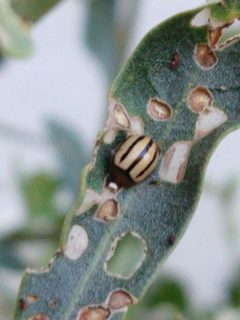
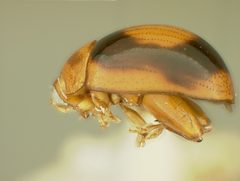
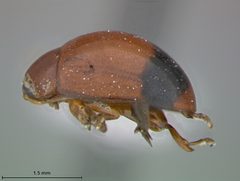
1Argopistes is a of approximately 50 described of flea beetles in the tribe Alticini. The genus is notable as the only group of flea beetles specialized for feeding on plants in the Oleaceae. Species occur worldwide, with documented in Asia, Africa, Madagascar, Japan, Taiwan, and North America. Several species are economically significant as pests of olive trees or as agents for privet.
Pronunciation
How to pronounce Argopistes: /ˌɑːrɡoʊˈpɪstiːz/
These audio files are automatically generated. While they are not always 100% accurate, they are a good starting point.
Images
Habitat
of trees in the Oleaceae, including olive groves, wild olive areas, and forests containing privet, ash, lilac, and related . occupy leaf surfaces; larvae inhabit leaf mines within host foliage.
Distribution
Worldwide distribution including Asia (China, Japan, Taiwan), Africa (South Africa, Namibia, Madagascar), and introduced in North America (southeastern United States).
Diet
Specialized herbivory on Oleaceae. feed on leaves, stems, and occasionally flowers or fruits. Larvae are leaf miners that feed between leaf layers. Documented include Olea europaea (olive), Ligustrum sinense (Chinese privet), Ligustrum vulgare, Syringa meyeri, Chionanthus virginicus, Forestiera , and Fraxinus pennsylvanica.
Host Associations
- Olea europaea subsp. cuspidata (African Wild Olive) - food plantNative in southern Africa
- Olea europaea subsp. europaea (European cultivated olive) - food plantAgricultural in southern Africa
- Ligustrum sinense (Chinese privet) - food plant for A. tsekooni in Asia and introduced North American
- Ligustrum vulgare - food plantAccepted in no-choice and choice tests
- Syringa meyeri - food plantAccepted in choice tests
- Chionanthus virginicus - food plantAccepted in choice tests
- Forestiera acuminata - food plantAccepted in choice tests
- Forestiera pubescens - food plantAccepted in choice tests
- Forestiera segregata - food plantAccepted in choice tests
- Fraxinus pennsylvanica - food plantAccepted in choice tests
Life Cycle
Complete with three larval instars. laid in cavities chewed into leaf , enclosed in hardened excrement . Larvae mine within leaves, with first two instars feeding exclusively inside leaf tissue. Third instar completes feeding within leaf then drops to ground to pupate in soil. Multiple per year reported (three overlapping generations in Anhui Province, China; three generations per year in Western Cape, South Africa). Overwinters as .
Behavior
possess enlarged hindleg enabling jumping when disturbed. Some show microhabitat partitioning: adults of certain species primarily inhabit leaf undersides while others occupy both leaf surfaces. Larvae exhibit species-specific mining including frequency of mine-switching and body positioning (-up versus -up) that appear adapted to evergreen versus deciduous plants. adults become lethargic in cold weather and feed sporadically on warmer days.
Ecological Role
Specialized herbivore on Oleaceae. Heavy can cause significant defoliation, exposing lower leaf to sunlight and causing loss of vigor, particularly under hot and dry conditions. Can be detrimental to young plant development and may lead to death if uncontrolled. Considered among the most important pests of olive trees in some regions. Some have been evaluated or deployed as agents for Ligustrum species.
Human Relevance
Agricultural pest of olive in southern Africa, where A. sexvittatus and A. capensis cause substantial damage to commercial and wild olive trees. A. tsekooni has been introduced to southeastern North America as a agent for Chinese privet (Ligustrum sinense), though range testing indicates potential non-target effects on native Oleaceae including ash, lilac, and native Forestiera species.
More Details
Evolutionary specialization
Argopistes represents the only known lineage of flea beetles (Alticini) that has evolved specialization on Oleaceae plants, representing a distinctive evolutionary within the tribe.
Taxonomic activity
Recent taxonomic work has described new from Taiwan (three species) and Madagascar (six species), indicating ongoing diversification and discovery within the .
Morphological variation
A. sexvittatus exhibits striped and black in South African .
Sources and further reading
- BugGuide
- Wikipedia
- GBIF taxonomy match
- iNaturalist taxon
- NCBI Taxonomy
- Argopistes sexvittatus and Argopistes capensis (Chrysomelidae: Alticini): Mitogenomics and Phylogeny of Two Flea Beetles Affecting Olive Trees
- Host Plant Preference of Fleabeetle Argopistes biplagiatus MOTSCHULSKY Adults(Coleoptera:Chrysomelidae)
- Habitat selection of two fleabeetle species of the genus Argopistes (Coleoptera: Chrysomelidae) on their host trees.
- Host Specificity of Argopistes tsekooni (Coleoptera: Chrysomelidae), a Potential Biological Control Agent of Chinese Privet
- Studies on the life history of the fleabeetle, Argopistes coccinelliformis Csiki (Coleoptera: Chrysomelidae). II. Developmental ability on various host trees.
- Argopistes tsekooni (Coleoptera: Chrysomelidae), a new natural enemy of Chinese privet in North America: identification, establishment, and host range
- Studies on the Life History of the Fleabeetle, Argopistes coccinelliformis CSIKI(Coleoptera: Chrysomelidae). V. Effects of Food Conditions on Oviposition.
- Life history of the flea beetle, Argopistes coccinelliformis Csiki(Coleoptera: Chrysomelidae). VII. Effects of photoperiod and temperature on induction of reproductive diapause in newly emerged adults.
- Biology and Life History of Argopistes tsekooni (Coleoptera: Chrysomelidae) in China, a Promising Biological Control Agent of Chinese Privet
- Life history of the flea beetle, Argopistes coccinelliformis Csiki (Coleoptera : Chrysomelidae) : VI. Overwintering and oviposition abilities of adults which emerged late in the season
- Host Specificity of <I>Argopistes tsekooni</I> (Coleoptera: Chrysomelidae), a Potential Biological Control Agent of Chinese Privet
- The genus Argopistes Motschulsky from Japan and Taiwan, with descriptions of three new species from Taiwan (Coleoptera, Chrysomelidae, Galerucinae, Alticini).
- Argopistes Motschulsky from Madagascar with descriptions of six new species (Coleoptera, Chrysomelidae, Galerucinae, Alticini).