
Agasicles hygrophila
Selman & Vogt, 1971
Alligatorweed Flea Beetle, Alligator Weed Flea Beetle
Agasicles hygrophila is a small leaf beetle in the Chrysomelidae, native to South America and widely introduced as a agent for the aquatic weed Alternanthera philoxeroides (alligator weed). It was the first insect studied for of an aquatic weed. The exhibits strict monophagy, feeding and reproducing exclusively on alligator weed. Both larvae and feed on leaves, causing defoliation that can kill dense weed mats and clear infested waterways. The has been established in at least 30 countries including the United States, New Zealand, China, and Australia.
Pronunciation
How to pronounce Agasicles hygrophila: /əˈɡæsɪkliːz haɪˈɡrɒfɪlə/
These audio files are automatically generated. While they are not always 100% accurate, they are a good starting point.
Identification
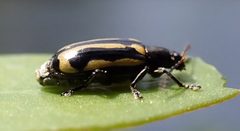
Distinguished from other flea beetles by the combination of small size (5 mm), black body with yellow stripes on , and exclusive association with Alternanthera philoxeroides. The striped pattern differs from many other Agasicles . In introduced ranges, no other flea beetle shares this specific association. in abdominal structure allows sex determination of .
Images
Appearance
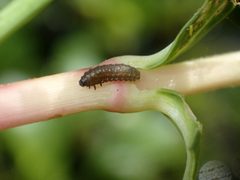
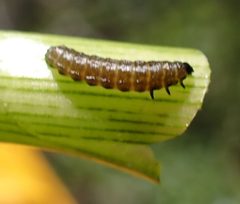
are approximately 5 mm in length with a compact, flea beetle body form. The body is primarily black with distinctive yellow stripes on the . Females are larger than males and exhibit in abdominal structure: females have exposed abdominal segments, while males have a covered with retractable genitalia concealed in the 5th sternite. Larvae are small and yellow. are approximately 1 mm long and laid in rows on leaves.
Habitat
Strictly associated with aquatic and semi-aquatic where its plant Alternanthera philoxeroides grows, including lakes, ponds, rivers, canals, and wetlands. In laboratory settings, reared at 25±1°C with 80±5% relative humidity and 14-hour light:10-hour dark . Naturalized persist only where alligator weed occurs.
Distribution
Native to South America; introduced and established in the southeastern United States, New Zealand, China, Australia, and at least 27 additional countries for purposes. GBIF records confirm presence in North America, South America, Southern Asia, and Australia.
Diet
Strictly monophagous, feeding exclusively on Alternanthera philoxeroides (alligator weed). Both larvae and consume leaves. Diet specificity has remained stable for many years post-introduction, with no range expansion documented. Host plant quality, particularly foliar nitrogen content, significantly affects larval development rate and survival.
Host Associations
- Alternanthera philoxeroides - exclusive Required for feeding, development, and ; strict monophagy confirmed across native and introduced ranges
Life Cycle
Females lay approximately 1,000 over their six-week lifetime. Eggs are deposited in rows on leaves. Larvae emerge and feed on leaves, with development rate and survival strongly influenced by foliar nitrogen content and temperature. Larval development time decreases with increasing nitrogen regardless of temperature. emerge and continue feeding on leaves. Specific details of and stages not documented in available sources.
Behavior
Uses volatile chemical cues for location and recognition, specifically (E)-4,8-dimethyl-1,3,7-nonatriene (DMNT) released by damaged host plants. contact and feeding induce upregulation of nerolidol synthase genes in the host plant, increasing DMNT biosynthesis and release, which facilitates host finding by conspecifics. Prefers volatiles from plants previously fed upon by conspecifics for 24 hours over undamaged plants. Odorant receptor co-receptor (ORco) is essential for both host allocation and mate-seeking ; RNAi of ORco significantly impairs both functions. Multiple odorant-binding proteins expressed in larvae and are implicated in olfactory-mediated behaviors.
Ecological Role
herbivore and agent that reduces of the weed Alternanthera philoxeroides. Defoliation by larvae and can kill dense weed mats, clearing infested waterways and reducing economic losses from hindered river transportation, agricultural irrigation, and crop production. Also mitigates ecological impacts of alligator weed on native wildlife in invaded areas. Population efficacy varies with seasonal changes in plant nitrogen content and temperature.
Human Relevance
Widely employed as a agent for alligator weed in at least 30 countries. First insect ever studied for of an aquatic weed. Successful establishment has provided cost-effective, self-sustaining weed management in many regions. Research subject for studies on insect olfaction, -finding , RNAi mechanisms, and climate change effects on biological control agents.
Similar Taxa
- Other Agasicles speciesShare -level morphological traits; distinguished by elytral color pattern and association
- Other flea beetles (Halticinae)Similar body form and jumping ability; distinguished by specific black-and-yellow striped pattern and exclusive alligator weed association
More Details
Olfactory Biology
The has been extensively studied as a model for insect olfaction and -finding. Research has identified 38 odorant-binding proteins, with specific OBPs differentially expressed between and first-instar larvae. The receptor and three vitellogenin genes have been characterized for their roles in . receptor Methoprene-tolerant (Met) gene regulates reproduction under elevated CO2 conditions.
Climate Sensitivity
Cold hardiness limits potential geographic distribution; thermal has been studied to predict establishment limits. Periodically repeated heat events negatively affect and ovary development. Elevated CO2 conditions influence reproductive regulation through hormonal .
Sources and further reading
- BugGuide
- Wikipedia
- GBIF taxonomy match
- iNaturalist taxon
- NCBI Taxonomy
- Alligatorweed flea beetle Agasicles hygrophila Selman and Vogt (Coleoptera: Chrysomelidae: Halticinae)
- Cold hardiness of the biological control agent, Agasicles hygrophila, and implications for its potential distribution
- Agasicles hygrophila attack increases nerolidol synthase gene expression in Alternanthera philoxeroides, facilitating host finding
- Variability in weed biological control : effects of foliar nitrogen on larval development and dispersal of the alligatorweed flea beetle, Agasicles hygrophila
- Juvenile hormone receptor Methoprene-tolerant (Met) gene regulates the reproduction of Agasicles hygrophila under elevated CO2
- RNAi verifications on olfactory defects of an essential biocontrol agent Agasicles hygrophila (Coleoptera: Chrysomelidae) regarding mating and host allocation
- Identification and Characterization of the Vitellogenin Receptor Gene and Its Role in Reproduction in the Alligatorweed Flea Beetle, Agasicles hygrophila
- Effects of Periodically Repeated Heat Events on Reproduction and Ovary Development ofAgasicles hygrophila(Coleoptera: Chrysomelidae)
- The potential geographical distribution of alligator weed (<i>Alternanthera philoxeroides</i>) and a biological control agent, <i>Agasicles hygrophila</i>, in New Zealand
- Identification and Expression Patterns of Three Vitellogenin Genes and Their Roles in Reproduction of the Alligatorweed Flea Beetle Agasicles hygrophila (Coleoptera: Chrysomelidae)
- Transcriptome analysis used to identify and characterize odorant binding proteins in Agasicles hygrophila (Coleoptera: Chrysomelidae)