
Lexiphanes
Gistel, 1848
Species Guides
6- Lexiphanes affinis
- Lexiphanes guerini
- Lexiphanes mexicanus(Mexican case-bearing leaf beetle)
- Lexiphanes saponatus
- Lexiphanes seminulum
- Lexiphanes teapensis
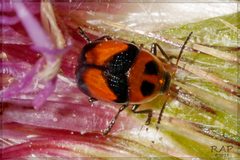
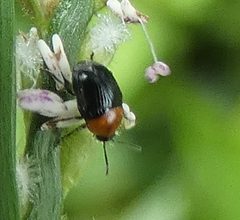
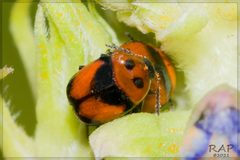
Lexiphanes is a of case-bearing leaf beetles in the Chrysomelidae, Cryptocephalinae, containing approximately 17 described . The genus is distributed across North and South America, with species recorded from eastern Brazil to northern North America. Members of this genus are associated with specific plants, with documented associations including Cassandra calyculata and Waltheria indica.
Pronunciation
How to pronounce Lexiphanes: /lɛkˈsɪfəneɪz/
These audio files are automatically generated. While they are not always 100% accurate, they are a good starting point.
Images
Habitat
Vegetation of specific plants. For L. saponatus, larvae inhabit the host plant itself rather than leaf litter, moving freely on Cassandra calyculata. Another has been recorded on flowers of Waltheria indica in eastern Brazil.
Distribution
North America and South America. Documented from eastern Brazil and northern North America (Nearctic region). GBIF records indicate presence in Colombia.
Host Associations
- Cassandra calyculata - plantLarval for L. saponatus; larvae move freely on plant and mimic buds
- Waltheria indica - plantFlowers; first record for in eastern Brazil
Life Cycle
Complete with , larva, and pupa stages. For L. saponatus: overwinters as larva in first or second instar; uncertain whether occurs following warm season or requires second . Laboratory rearing of an unidentified recorded 66.5 days from egg to .
Behavior
Larva of L. saponatus exhibits exceptional bud mimicry on plant, becoming nearly invisible even to trained observers. Unlike most Cryptocephalinae larvae, which are restricted to leaf litter and cannot climb plants, L. saponatus larvae move freely on vegetation.
Similar Taxa
- SuffrianusLarva of L. saponatus shows morphological resemblances; distinguished by large papillate frontal setae in Lexiphanes
- ChlamisinaePupa of L. saponatus resembles Chlamisinae pupae in general form; distinguished by distinctive projections on seventh and ninth abdominal segments in Lexiphanes
More Details
Taxonomic history
established by Gistel in 1848 (or 1836 according to GBIF, though Catalogue of Life accepts 1848). Placed in tribe Cryptocephalini, subtribe Monachulina.
Research significance
L. saponatus was the first Nearctic Cryptocephalinae for which all stages were described, representing a significant gap in knowledge of this in North America.
Larval ecology
The free-living, plant-climbing of L. saponatus larvae contrasts with the ground-dwelling, leaf-litter restricted habits typical of most Cryptocephalinae, suggesting ecological diversification within the .
Sources and further reading
- BugGuide
- Wikipedia
- GBIF taxonomy match
- iNaturalist taxon
- NCBI Taxonomy
- Catalogue of Life
- EGG, LARVA, AND PUPA OF LEXIPHANES SAPONATUS (COLEOPTERA: CHRYSOMELIDAE: CRYPTOCEPHALINAE)
- The Neotropical novelty of Lexiphanes Gistel, 1848 (Coleoptera: Chrysomelidae) on Waltheria indica L., 1753 (Malvales: Malvaceae), with life cycle notes on its immatures