
Cryptocephalus leucomelas
Suffrian, 1852
Bi-blotched Cryptocephalus
Cryptocephalus leucomelas is a case-bearing leaf beetle in the Chrysomelidae, measuring 4.0–6.0 mm in length. It is distributed across North America, including the United States and Canada. The belongs to a commonly known as case-bearing leaf beetles, with larvae that construct protective cases from fecal material and shed skins. Three have been described: C. l. leucomelas, C. l. trisignatus, and C. l. vitticollis.
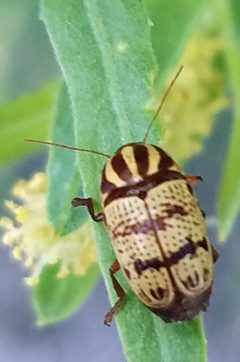
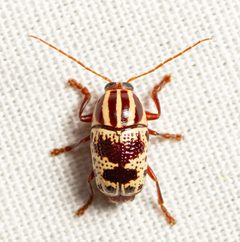
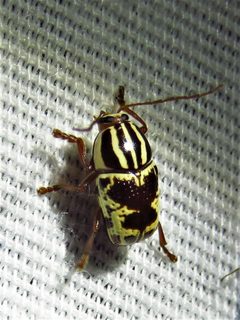
Pronunciation
How to pronounce Cryptocephalus leucomelas: //ˌkɹɪptoʊˈsɛfələs ˌljuːkoʊˈmɛləs//
These audio files are automatically generated. While they are not always 100% accurate, they are a good starting point.
Identification
The three recognized differ in markings and coloration: C. l. leucomelas (Suffrian, 1852), C. l. trisignatus (R. White, 1968), and C. l. vitticollis (J. L. LeConte, 1880). Subspecies C. l. trisignatus and C. l. vitticollis can be distinguished from the nominate subspecies by their specific pattern variations. Within the Cryptocephalus, C. leucomelas may be distinguished from similar by its characteristic size range and the black-and-white coloration implied by its name, though specific diagnostic features require examination of original descriptions.
Images
Appearance
measure 4.0–6.0 mm (0.16–0.24 in) in length. As a member of the Cryptocephalus, adults likely exhibit the compact, rounded body form typical of case-bearing leaf beetles, with hardened forewings () that completely cover the . The specific epithet "leucomelas" (from Greek leukos "white" and melas "black") suggests a black-and-white color pattern, though detailed coloration is not documented in available sources.
Habitat
Specific associations are not documented for this . Based on -level patterns, Cryptocephalus species are typically found on vegetation in open to semi-open habitats including prairies, meadows, forest edges, and riparian areas. The species has been collected in sand prairie remnants in Missouri.
Distribution
North America, including the United States and Canada. Specific state/provincial records are not comprehensively documented, though the has been recorded in Missouri sand prairies.
Seasonality
activity period is not specifically documented. Based on related in the , adults are likely active during spring and summer months.
Life Cycle
As with all Cryptocephalus , larvae are case-bearers that construct portable protective cases from their own fecal material combined with shed skins. Larvae feed externally on plant foliage while carrying their cases. Specific plants for C. leucomelas are not documented; the single specimen noted from sweeping Polygonellum americanum (American jointweed) in Missouri sand prairie was found in association with this plant, though this may reflect rather than host specificity.
Ecological Role
As a folivorous , larvae and likely function as primary consumers in their . The case-bearing habit of larvae provides protection from and desiccation. Specific ecological impacts are not documented.
Human Relevance
No direct economic or agricultural significance is documented. The is of interest to entomologists and naturalists, with 726 observations recorded on iNaturalist as of the data cutoff.
Similar Taxa
- Other Cryptocephalus speciesMembers of this share the case-bearing larval habit and compact , requiring careful examination of color pattern, size, and genitalia for definitive identification.
More Details
Subspecies
Three are recognized, suggesting geographic variation in across the ' range. The subspecies were described by different authors over a century apart (1852–1968), indicating ongoing taxonomic refinement.
GBIF Status
The Global Biodiversity Information Facility lists this with status 'DOUBTFUL', which may reflect taxonomic uncertainty or data quality issues requiring verification.