
Bassareus mammifer
(Newman, 1840)
Red-Banded Bassar
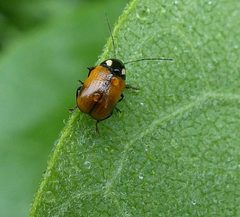
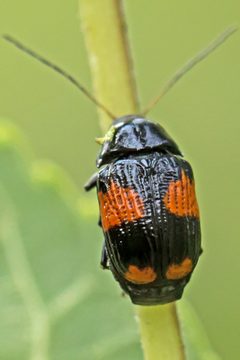
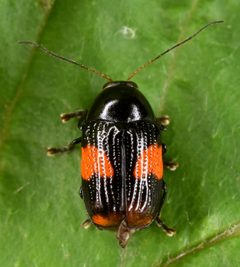
Bassareus mammifer is a case-bearing leaf beetle in the Chrysomelidae, commonly known as the Red-Banded Bassar. The is characterized by its distinctive red banding pattern and is found across North America, with documented records from Canada and the United States. As a member of the Cryptocephalinae , larvae construct protective cases from fecal material and shed .
Pronunciation
How to pronounce Bassareus mammifer: /bæsəˈrɛəs ˈmæmɪfər/
These audio files are automatically generated. While they are not always 100% accurate, they are a good starting point.
Identification
Distinguished from other Bassareus by the red banding pattern on ; however, precise diagnostic features separating it from are not well established in accessible literature. The combination of compact body form, case-bearing larval habit, and geographic distribution may aid identification.
Images
Appearance
display reddish-orange banding across the , with the 'Red-Banded Bassar' reflecting this pattern. Body form is compact and convex, typical of case-bearing leaf beetles. Specific size measurements and detailed color patterns are not well documented in available sources.
Habitat
Specific preferences are not documented; inferred from characteristics to include vegetation where larval case construction and feeding occur.
Distribution
North America, with confirmed records from Alberta, Manitoba, and New Brunswick in Canada, and presence documented in the United States.
Seasonality
Activity patterns not documented in available sources.
Life Cycle
As a member of Cryptocephalinae, larvae are known to construct portable cases from fecal material and , carrying them throughout development. Specific details for B. mammifer are not documented.
Behavior
not documented; larval case-bearing habit inferred from membership.
Similar Taxa
- Other Bassareus speciesSimilar body form and coloration; precise differentiation requires examination of subtle morphological features not detailed in available sources.
More Details
Taxonomic note
The 'Red-Banded Bassar' is used on iNaturalist, though this name is not widely established in formal taxonomic literature.
Data gaps
Despite 523 iNaturalist observations, detailed biological information remains sparse in accessible scientific literature.