
Anomoea laticlavia
(Forster, 1771)
Clay-colored Leaf Beetle, Persimmon Beetle
Species Guides
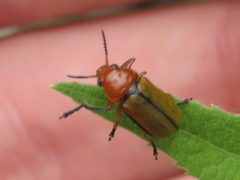
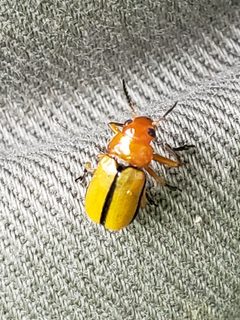
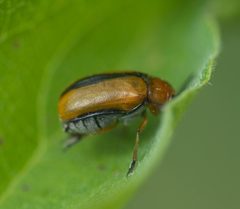
1Anomoea laticlavia is a case-bearing leaf beetle native to central and eastern North America. measure 7–12 mm and display distinctive reddish-brown with a variable-width black . The belongs to the unranked Camptosomata, characterized by larvae that construct portable cases from fecal material and shed skins. Adults feed on leaves of various plants including legumes, persimmons, oaks, willows, and ragweed, while larvae are subterranean root or litter feeders. Some Florida have been recognized as a distinct .
Pronunciation
How to pronounce Anomoea laticlavia: /ˌænəˈmiːə ˌlætɪˈkleɪviə/
These audio files are automatically generated. While they are not always 100% accurate, they are a good starting point.
Identification
Distinguished from similar leaf beetles by the combination of reddish-brown with a prominent black and the case-bearing larval habit characteristic of Camptosomata. The variable width of the black suture provides a useful diagnostic feature. Males can be recognized by their enlarged front legs.
Images
Appearance
are 7–12 mm in length. The are reddish-brown with a conspicuous black of variable width running along the midline. Males possess relatively enlarged front legs compared to females. As a member of Camptosomata, larvae construct portable cases from their own fecal material and shed skins, carrying these cases while feeding.
Habitat
Occurs in diverse supporting its broad plant range, including areas with legumes, persimmons, oaks, willows, and ragweed. Larvae inhabit soil where they feed on roots or in leaf litter.
Distribution
Native to central and eastern North America. Some Florida represent a recognized .
Diet
feed on leaves of Fabaceae (legumes), persimmons (Diospyros), oaks (Quercus), willows (Salix), and ragweed (Ambrosia). Larvae are subterranean root or litter feeders; specific larval plants have not been documented.
Host Associations
- Fabaceae - feedinglegumes
- Diospyros - feedingpersimmons
- Quercus - feedingoaks
- Salix - feedingwillows
- Ambrosia - feedingragweed
Life Cycle
Complete with case-bearing larvae. Larvae construct portable cases from fecal material and shed skins, feeding subterranean on roots or in leaf litter. occurs within the larval case.
Behavior
are leaf-feeders on a broad range of plants. Larvae exhibit the characteristic case-bearing of Camptosomata, constructing and carrying protective cases while moving through soil or litter.
Ecological Role
Herbivore in both and larval stages. Adults function as folivores on diverse woody and herbaceous plants; larvae contribute to soil as root or detritus feeders.
Human Relevance
Minor agricultural or horticultural pest potential given broad range, though not documented as economically significant. The "Persimmon " reflects association with cultivated persimmons.
Similar Taxa
- Other Anomoea speciesSimilar size and general body form; distinguished by specific coloration pattern of reddish-brown with black
- Other CamptosomataShare case-bearing larval habit; distinguished by coloration and plant associations