
Prasocuris
Latreille, 1802
Species Guides
3- Prasocuris boreella
- Prasocuris phellandrii
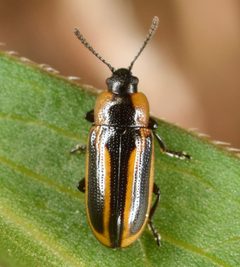
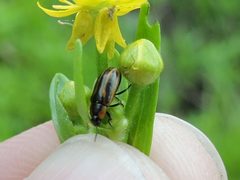
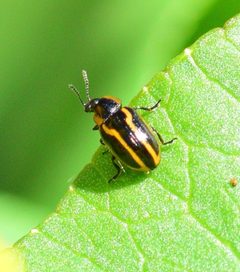
- Prasocuris vittata(Banded Leaf Beetle)
Prasocuris is a of leaf beetles in the Chrysomelinae, established by Latreille in 1802. The genus includes approximately seven described , some of which have been historically classified in the subgenus Hydrothassa. Species within this genus are associated with wetland and riparian , with documented plant relationships to aquatic or semi-aquatic vegetation.
Pronunciation
How to pronounce Prasocuris: /ˈpræsoʊˌkjʊərɪs/
These audio files are automatically generated. While they are not always 100% accurate, they are a good starting point.
Images
Habitat
Wetland and riparian environments; associated with aquatic and semi-aquatic vegetation.
Distribution
Recorded from Denmark, Norway, and Sweden; at least one (Prasocuris phellandrii) has been studied in Moravia, Czech Republic.
Diet
Herbivorous; Prasocuris phellandrii has been documented in association with plants, though specific plant are not detailed in available sources.
Similar Taxa
- HydrothassaHistorically treated as a subgenus of Prasocuris (as Hydrothassa Thomson, 1859), with some sources still recognizing it as a separate . such as Prasocuris boreella, P. obliquata, P. ovalis, and P. vittata have been classified under this subgenus.
More Details
Taxonomic complexity
The contains two subgenera: Hydrothassa (sometimes elevated to genus rank) and Prasocuris sensu stricto. This creates taxonomic instability in classification.
Species list
Accepted include: Prasocuris boreella (Schaeffer, 1928), P. junci (Brahm, 1790), P. obliquata J. L. LeConte, 1866, P. ovalis Blatchley, 1910, P. phellandrii (Linnaeus, 1758), and P. vittata (Olivier, 1807).