
Plagiodera arizonae
Crotch, 1873
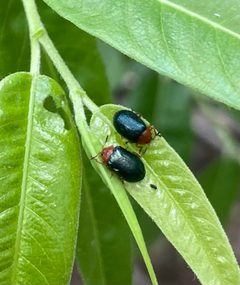
Plagiodera arizonae is a leaf beetle in the tribe Chrysomelini, to Arizona. The species exhibits distinctive coloration with black contrasting against a red and legs. It belongs to a of leaf beetles associated with willow and poplar .
Pronunciation
How to pronounce Plagiodera arizonae: //plædʒiːoʊˈdɪəra əˌrɪˈzoʊniː//
These audio files are automatically generated. While they are not always 100% accurate, they are a good starting point.
Identification
Distinguished from other Plagiodera by its restricted Arizona distribution and the specific combination of black with red and legs. The Plagiodera is characterized by small, oval leaf beetles with enlarged hind adapted for jumping.
Images
Appearance
have black (wing covers), red , and red legs. The contrasting color pattern of black body with red appendages is distinctive within the .
Habitat
Associated with riparian and woodland in Arizona where plants (willows and poplars, Salix and Populus) occur.
Distribution
to Arizona, United States. GBIF records indicate presence in North America and Middle America, with confirmed occurrence in Arizona.
Diet
Larvae and feed on leaves of willows (Salix spp.) and poplars (Populus spp.), based on documented associations for the Plagiodera.
Host Associations
- Salix - larval and food plant-level association for Plagiodera
- Populus - larval and food plant-level association for Plagiodera
Ecological Role
Herbivore that consumes leaves of woody riparian vegetation; contributes to nutrient cycling and serves as prey for .
Similar Taxa
- Plagiodera versicoloraSimilar size and body shape, but P. arizonae is geographically restricted to Arizona while P. versicolora has broader distribution; color patterns differ
- Other Chrysomelini leaf beetlesShare characteristics but differ in associations and coloration patterns
More Details
Taxonomic note
Described by Crotch in 1873. The epithet 'arizonae' reflects its type locality and distribution in Arizona.
Observation frequency
iNaturalist records indicate 249 observations, suggesting the is moderately well-documented by naturalists.