
Phratora purpurea
Brown, 1951
aspen skeletonizer
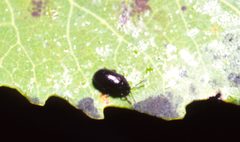
Phratora purpurea, known as the aspen skeletonizer, is a leaf beetle in the Chrysomelidae. It occurs across North America from the Northwest Territories to Ontario and south to Maryland and New York. The feeds on willows and poplars, with documented including Populus tremuloides, P. grandidentata, P. balsamifera, and Salix fragilis. emerge from in spring, with peak mating and -laying activity in mid-June.
Pronunciation
How to pronounce Phratora purpurea: /fræˈtoʊrə pərˈpjʊriə/
These audio files are automatically generated. While they are not always 100% accurate, they are a good starting point.
Identification
Deep purple or coppery red coloration distinguishes this from many other Phratora. The specific association with poplars and willows may aid identification, though confirmation requires examination of morphological characters.
Images
Habitat
Associated with supporting its plants: willows (Salix) and poplars (Populus), including aspen stands.
Distribution
North America, including Maryland, New York, Ontario, British Columbia, and the Northwest Territories.
Seasonality
emerge from in spring. Active mating and -laying occurs in mid-June. Adults disappear as eggs and larvae appear. New adults emerge in late summer.
Diet
Feeds on willows and poplars. Documented : Populus tremuloides (quaking aspen), Populus grandidentata (bigtooth aspen), Populus balsamifera (balsam poplar), and Salix fragilis (crack willow). Larvae feed on host plant leaves.
Host Associations
- Populus tremuloides - food plantquaking aspen
- Populus grandidentata - food plantbigtooth aspen
- Populus balsamifera - food plantbalsam poplar
- Salix fragilis - food plantcrack willow
Life Cycle
are laid in clutches of 6–15, arranged in two rows on the underside of plant leaves. First instar larvae feed in groups side by side in a single row. Second and third instars feed in smaller groups or solitarily. occurs in soil, not on the host plant. emerge in late summer, then overwinter.
Behavior
Larvae exhibit progressive change in feeding : first instars feed in coordinated groups, later instars become more solitary. are present in spring, disappear during larval development, and re-emerge in late summer.
Ecological Role
Herbivore on Populus and Salix . Larval feeding skeletonizes leaves (hence the ).
Similar Taxa
- Other Phratora speciesShare similar leaf beetle and associations with Salicaceae; distinguished by coloration and specific host preferences where documented.
More Details
Sources and further reading
- BugGuide
- Wikipedia
- GBIF taxonomy match
- iNaturalist taxon
- NCBI Taxonomy
- Are Honeybees the Most Effective Pollinators? | Bug Squad
- Monroe Canyon epilogue – Audubon’s tiger beetle | Beetles In The Bush
- Lewis Ocean Bay Heritage Preserve & Wildlife Management Area | Beetles In The Bush
- Bug Eric: Cow Path Tiger Beetle
- Bug Eric: Springtime Tiger Beetles